Snippets

Happy Birthday Doug was written and performed by Drew Droege. Mostly we hear the one side of guests’ conversations with Doug at his celebration in a Los Angeles wine bar. As an actor, Droege was superb in creating the different characters with his body and his intonations. His writing was equally as good. In a few sentences, I could grasp the  essence of each character was. But I was confused by one thing. The credits, of course, listed Droege, a director, a production stage manager, and an assistant stage manager. But the credits also told me there were eight producers and an associate producer. The set was a few tables and glasses, and the play was sixty minutes long. I wonder what the eight producers and an associate actually did. I just don’t understand show business.

 “We all indulged in wine and were soon astonished at our scintillating wit.” Daphne Phelps, A House in Sicily.

Have you wondered what Covid-18, or Covid-12, or especially Covid-7 is?

I increasingly see “survivor” with discussions of sexual assaults. Apparently, this is the politically correct term instead of “victim.” Why?

Spring comes again. I think that’s nice.

It is a season of which I’m fond.

Soon the beer bottles on the ice

Will disappear into the pond.

                   Richard Moore

          In my running days, I ran a lot of races, most often ten kilometers long and more in Central Park than anywhere else. I was running 10K races before I tried marathons. When I started doing those long races, I saw the 10K races as speed workouts for a marathon. My goal was to run the 10K in 6-minute miles, and on good days I accomplished that. 10K was basically one loop around Central Park, but it was a tough 10K because the road went up and down with a big hill on the north end of the park. My indelible memory of that hill came from a couple of winter races.  We ran counterclockwise, starting on the east side of the Park near the Metropolitan Museum.  The hill came fairly soon with the road climbing and turning to the left. I could not see far ahead and was always unsure how much more of the hill was left. As I was struggling during those races, I would smell a cigar up above and around a bend. Then he would appear running against our traffic. He was older than most of the racers, maybe mid-50s. He seemed thirty pounds overweight. This was less of a guess than it might have been because even though it was well below freezing, sometimes in the teens, he was running bare chested.  And he was smoking a big cigar with a grin as he ran.  I saw him at least during two races, and each time I had not yet crested the big hill.  Seeing him made me smile, and somehow made the struggle to the top easier.

          Joseph Chamberlin, the elderly leader of the Opposition in the British House of Commons, supposedly replied when asked how he kept his seeming youth: “Never walk if you can drive; and of two cigars always choose the longest and the strongest.” (He collapsed shortly afterwards, and his health declined rapidly.)

Democracy Indexed and Flawed (concluded)

You might also say that the increasingly undemocratic representation in the Senate is what the founders of the country created. Yes, of course, those who wrote and adopted the Constitution mandated that all states, big or small or in between, would get two seats in the upper house. And perhaps that provision was necessary to get the thirteen states to meld into one country, but that, of course, does not mean that it is right for today. Those founders, unless they were on substances much different from the copious amounts of cider they drank, could not have imagined states with populations approaching 40 million.

The Constitutional framers did not create a Senate with hopes that a small portion of the population would control the Senate. A national census had not been undertaken when the Constitution was drafted, but the drafters’ views of the relative populations of the states can be seen in the Constitution’s Section 2 of Article I where the document prescribed the allocation of Representatives for the original House. New Hampshire would have three, Massachusetts eight, Rhode Island one, Connecticut five, New York six, New Jersey four, Pennsylvania eight, Delaware one, Maryland six, Virginia ten, North Carolina five, South Carolina five, and Georgia three, for a total of sixty-five.

The framers thought that the three largest states (this calculation included the infamous three-fifths clause) would have twenty-six representatives, indicating the belief that Virginia, Massachusetts, and Pennsylvania had 40% of the population. Both Maryland and New York were allocated six Representatives. These five states, the framers believed, had about 57% of the population. Together, of course, they had ten seats in the twenty-six-person Senate, or about 38% of the Senators, while the states with 43% of the population would have 62% of the Senators. This, of course, was an imbalance, but it was nothing like the coming disparity where 50% of the population is expected to live in just eight states by 2040. They will only have 16% of the Senators, and, of course, the minority of the population will have 84% of the Senators.  

Whether or not two-Senators-per-state is a good provision today, it is what we have because of what happened in 1787, not because we of today have determined it is the best policy for our governing structure. But even if almost all of us conclude that we should have some other way of allocating Senators, it won’t be changed. Of course, the Constitution can be amended, which requires approval from two-thirds of each house of Congress and ratification by three-quarters of the states. The states are treated equally, and the lack of approval from thirteen states, no matter what portion of the population they contain, dooms an amendment. The amendment process in general is difficult, but in reality it is impossible for changing the Senate’s composition. The Constitution’s amendment provision, Article V, says that “no State, without its Consent, shall be deprived of its equal Suffrage in the Senate.” I don’t think that I am being overly cynical by concluding that Alaska and Wyoming and other states will not give up their “equal” Senatorial representation.

There is another possibility for ameliorating the increasing undemocratic governmental structure. Large states such as Texas or California could divide themselves into four or six separate states, each with two Senators. The Constitution’s Section 3 of Article IV, however, says that such division can only be done with the consent of Congress. Again, I don’t think that I am being overly cynical by concluding that the Senate, where the overwhelming majority of Senators will come from the smallest states, is not going to approve the admission of such new states into the Union.

So . . . a smaller and smaller minority of the population will select a majority in the Senate. What, if in addition, the electoral college deviates further and further from the majority’s vote? Will “the people” see their government as legitimate? With these governmental structures unchangeable within our Constitutional confines, what will then happen?

The famed philosophers John Lennon and Paul McCartney seemed to advocate a mind change instead of a revolution when change might be desirable but difficult: “You say you want a revolution/ . . . But when you talk about destruction/ Don’t you know that you can count me out/ . . . You say you’ll change the constitution/Well, you know/We all want to change your head/You tell me it’s the institution/Well, you know/You better free your mind instead. . . .” But at least for me, I don’t think I can change my mind so that rule by an increasingly small minority in my country will really be all right. I don’t want to live in the equivalent of a banana republic.

But then what’s left? With no constitutional method for change, perhaps only the words of Jefferson show the path to a better democracy: “I hold it that a little rebellion now and then is a good thing, and as necessary in the political world as storms in the physical. . . . It is medicine necessary for the sound health of government.”

Or perhaps we should contemplate the words of Bobby Kennedy: “A revolution is coming—a revolution which will be peaceful if we are wise enough; compassionate if we care enough; successful if we are fortunate enough—but a revolution which is coming whether we will it or not. We can affect its character; we cannot alter its inevitability.”

We should start considering the extra-constitutional changes we are assuredly going to face.

Democracy Indexed and Flawed (continued)

          While the Democracy Index lists the United States as a flawed democracy, that categorization will be difficult for many of us to accept. Meanwhile, many who might entertain the idea of that limitation will assume that we are placed in the defective bin because of Trump’s election and his autocratic actions. The Democracy Index, first published in 2006, however, initially listed the United States as a flawed democracy in 2016 before Donald J. Trump became president. Trump may be the result, but he is not the cause, of a flawed democracy.

          And although we may mouth those Fourth-of-July words—government of the people, by the people, and for the people—a little reflection shows that we don’t really believe them. Just look at the polls about confidence in Congress, for example. If we thought that government is of, by, and for us, we should have great confidence in our governing officials and bodies. That is not so. If the U.S. were truly a good and strong democracy, would approval polls for Congress hover around the twenty percent mark?

          Perhaps the surprising aspect of the Democracy Index is that before 2016 it had us in the fully democratic category, for we have always had important problems that conflicted with a fully functioning democracy. We often repeat Lincoln’s of, by, and for formulation, but if our government was so good, how was it that when he uttered them, he was speaking at a cemetery that represented the ongoing slaughter of a civil war? And, of course, the “people” then did not include women, blacks, or Native Americans.

          We have progressed, but our democracy has never been close to perfect. Our Constitution has served us well in many respects. It formed separate states into one nation that has endured, but that does not mean that the Constitution is without flaws. It permits governments to take actions to undercut democratic values, perhaps something that this blog will explore more in the future, but it also created a structure with anti-democratic features, structures that increasingly make our country less democratic.

          We certainly are aware that our method of selecting our president is not fully democratic. If democracy requires that all votes be counted equally and the person with the most votes wins, then the candidate with three million fewer votes than the rival would not become president, but under our semi-democracy, that was the result. (I previously explored the electoral college on April 10, 2019 on this blog. https://ajsdad.blog/?s=electoral.)

          The electoral college, however, is at least roughly democratic in that each state’s electoral votes roughly mirror its population size. The Senate is another story.

          Within each state, the election for Senator is democratic. Every vote in Texas, for example, counts equally in choosing Ted Cruz as Senator, but within the country, votes for Senators are not equal. The Constitution allots Texas two senators. It also gives Wyoming two Senators even though the population of Texas is about fifty times the size of Wyoming’s. In other words, each Wyoming vote for a Senator counts as much as fifty voters in Texas. Hardly democratic.

And the Senate will be increasingly undemocratic. I don’t know the initial source of this statistic, but I have seen it in several publications: By 2040, 70% of the population will live in the fifteen largest states and therefore collectively have thirty Senators while 30% of Americans will have 70% of the Senate.

Of course, even though an ever smaller minority of the population will control the Senate, that does not mean that that minority will be able to legislate for the rest of us. The House of Representatives, even with partisan gerrymandering, more accurately reflects the population trends of the country. (Unrestrained gerrymandering is something for future consideration here.) Senators representing a small portion of the population, however, will be able to stop legislation, and that minority will be able to confirm judges, cabinet officers, and other federal officials. The majority of the country will have even less power than it does now as the Senate becomes more skewed, or we might say, the cracks in our democracy will become chasms.

You might question whether the population trends reflected in that 2040 prediction will continue. People are leaving high-cost-of-living states and moving elsewhere. It is true that California out-migration has exceeded its in-migration. That does not mean, however, that its population has declined. Instead, while the rate of its growth has slowed to a trickle, it still grew by 141,300 from 2018 to 2019, a 0.35% growth rate. However, Wyoming, the state with the smallest population, has fewer than 600,000 residents. Even if miraculously Wyoming grew by 20%, it would add fewer people to its population than California now does. Wyoming would continue to fall behind in this population race, but it will still have the same senatorial representation as California.

It is true that New York, with the fourth largest state population, has lost residents, but so have the small states of West Virginia and Alaska. The New Yorkers who leave do not get in their modern Conestoga wagons and go to these small states. Significant numbers are not heading to West Virginia, Alaska, or even Nebraska, whose growth rate from 2017 to 2018 was only slightly above California’s at 0.6%.

The population disparities among the states will only increase. At the end of the coming generation perhaps 20% of the population will select the Senate’s majority.

(Concluded March 9, 2020)

Democracy Indexed and Flawed

          I had not heard of the Democracy Index until a friend recently mentioned that the United States was listed on it as a “flawed democracy.” I later learned that the index is produced by the Economist Intelligence Unit, sister to The Economist magazine.

          The EIU bases its report on sixty indicators grouped into five categories (electoral process and pluralism, functioning of government, political participation, political culture, and civil liberties) yielding a numeric score capped at 10.00. Norway, with a score of 9.87, leads the list followed by Iceland (9.58), Sweden (9.39), New Zealand (9.39), and Finland (9.25.) Countries with scores of 8.0 to 6.0 are listed as flawed democracies, and the United States was given a 7.95 score.

          This made me wonder about how I or my fellow Americans would define “democracy.” One dictionary said democracy was “government by the people, especially rule of the majority; government in which the supreme power is vested in the people and exercised by them directly or indirectly through a system of representation usually involving periodically held free elections.” Another source said: “a system of government by the whole population of all the eligible members of a state, typically through elected representatives.” A third source: “the belief in freedom and equality between people, or a system of government based on this belief, in which power is held by elected representatives or directly by the people themselves.”

          These definitions raised all sorts of questions and thoughts. Democracy was government by “the people,” but what was the definition of that entity? Is it the same as “the eligible members of a state”? The whole population cannot vote in an election. Ten-year-olds don’t get to cast a ballot. Isn’t it important to define what the “eligible members of a state” ought to be for a democracy? If the franchise is restricted to a tiny part of the society, but the leaders are picked by majority vote of that small group, is it a democracy? I guess it is, at least according to one definition.

          One democracy definition emphasized majority rule, but I have heard of the “tyranny of the majority,” and wondered if we would consider a country democratic that horrendously oppressed all those not in the majority. And, if a system selects representatives with a plurality but not a majority, is it not democratic or is it a lesser form of democracy?

          One democracy definition said “free elections.” That is not a self-evident phrase. I was not sure how I would define it, or if it could be defined except by negative examples.

          Even though I felt as if I would know a democracy when I saw it, I was not sure that it could be defined. Part of the problem is that the definitions, like most definitions, were binary—something was either this or not this. Something was not “sort of” this or a “better or more complete version” of this. The Democracy Index, however, accepts a more inclusive notion of democracy. Many societies are democratic, but some are more democratic than others, and I probably thought along similar lines.

          I did think, however, that third definition included a component the others did not when it said a democracy was a system of government based on the belief of equality among people. For me, I realized, a facet of a better democracy is that the ability to vote is widespread, indicating equality among the people, and that all voters’ votes count the same, again indicating equality among the people. The elected representatives of the society are chosen by determining who had the most votes cast in an election where all the voters have equal access to cast ballots and all votes carry equal weight.

          I also noticed an important absence in all the definitions. They had agreed that a representative democracy had the electorate picking people to represent them in government. But the definitions do not say that the people or the electorate choose the form of government in which their representatives will govern. But surely, the structure of the government has something to do with democracy. And “democratic” countries can be structured in ways that seem to make them more or less democratic. If our government is a flawed democracy as the Democracy Index asserts, part of the reason is that the governmental structure we have makes votes unequal. Our form of government means that some Americans count much more than others in choosing those who run the country. We are not, and cannot, be equal under our form of government. And the people of today have not chosen the structures causing inequality and a lesser form of democracy. Our forebears did that.

(Continued March 6)

Snippets

I just read Sally Rooney’s first book, Conversations with Friends, and those who told me that it was well written and memorable were right. I thought about self-indulgent whining for days.

Most of my life I have read a lot, but I retain less of those books than I would like. I thought making a list might help me, and I now record every book I finish. I am reading Shalimar the Clown by Salman Rushdie. When I read about the twenty-four-course-minimum banquets it seemed vaguely familiar, but all the rest of the novel seemed fresh. I was glancing over my completed book list yesterday, and I saw that I had read Shalimar the Clown four years ago. Is there a point to my reading so much if I retain so little?

          “This is not a novel to be tossed aside lightly. It should be thrown with great force.” Dorothy Parker.

          Americans who are following politics should admire how resilient we New Yorkers are. We have survived in succession the mayoralties of Rudy Giuliani, Michael Bloomberg, and Bill De Blasio.

          “But politics never ends, because ambition never rests.” Richard Brookhiser, John Marshall: The Man Who Made the Supreme Court.

President Trump had objections to the South Korean movie Parasite. I assume that with the subtitles his lips got too tired.

I wondered about the line in the program that said the singer was “voted a Downbeat Critics’ Poll Rising Star Vocalist for four consecutive years.” Is there a limit on how long a person is a rising star? Apparently four years of rising is not enough. But Thana Alexa who is that singer was marvelous in the performance I saw at the Birdland Jazz Club the other night as were Caroline Davis, Carolina Calvache, Endea Owens, and Alison Miller on sax, piano, bass, and drums. (But since this performance, I attended a legal conference concerning neuroscience, and I learned that one of the panelists was “recognized as a ‘Rising Star’ Super Lawyer in New York in 2011, 2012, and 2013 and as a Super Lawyer in New York since 2015.” Maybe that is how it should be: three years of Rising, a year off, and then full Super status.)

          I tell myself that I miss running, but I concede that the compulsive running that I did in my thirties and forties gave me aches and pains. I was constantly sore. Unsolicited advice told me to stretch—some said before I set out, others after the run’s completion–but I never did. I thought that an easy pace at the beginning of the run was the best way to loosen up. Over time the soreness, especially in my knees, was constant, and towards the end of my running phase, I realized that I was hanging on tightly to bannisters to descend stairs because of knee problems. I knew that it was time to think about quitting.  When I saw a doctor for a routine physical, he told me that I was running too much. He said, “It just depends at what age you want a knee replacement.” I gave up running a bit later. I had a knee replacement when I was seventy.

          “In a dream you are never eighty.” Anne Sexton.

Food Markets and Sidewalks of Merida (concluded)

Not only food but real estate was also inexpensive in Yucatan. Our food tour guide Jose said that a nice, modern, two-bedroom, one bath apartment rented in Merida for about the equivalent of $315 a month. A few days later we met an American couple at the ruins of Uxmal. They had retired to Merida and bought what they described as a nice house with a pool on the outskirts of Merida for $135,000. (The two were gay and had moved from Galveston, Texas. One said that Merida was the most gay-friendly place he had been. Yucatan does not have gay marriage, but it recognizes single-sex marriages from other places.)

Merida is the increasingly sophisticated capital of Yucatan with a population of about one million people. All this seems to indicate that Merida should be a good place to set up a base, but it would not be for me. A desirable city must be good for walking. Many people did walk in Merida. Getting lost was not the issue; the city’s layout is easy to learn. But the sidewalks in central Merida are narrow. Two people could barely pass by each other. I could not linger and look in shop windows or study menus or look at architectural details of buildings because this meant disrupting the pedestrian flow. And nothing separated the sidewalks from the street. Small and large vans and buses zoomed and belched a matter of inches from my shoulders. I did not feel in especial danger, but all that noise and gas fumes left me jangly. I could get around on foot, but it was not an enjoyable activity. I don’t want to spend long times in a place where I don’t enjoy walking.

Merida sidewalk. Photo by the NBP

And the climate is not my cup of tequila either. For me, Merida and Yucatan in general were hot and humid. I could not walk more than a few steps without feeling sticky. As a brief respite from New York’s January, it was fine, but I would not relish that weather on a longer term basis.

Of course, there is the chance that if I regularly encountered the climate, I would adjust. Several Yucatecans said that the weather in January was cool for them. They were bundled up, and I even spotted people with handwarmers. When any found out I was from New York, the first reaction was to mention that it was cold up there. The food tour guide said he thought of living in Canada for a while to improve his English, but he almost immediately said that he was concerned about the weather. (He was also concerned about his ability to learn English in Canada, and not because of the French-speaking areas. He had considered working on a Canadian farm, but then he heard that it was likely that most of the farm workers would be Spanish speakers.) Jose would have preferred to come to the United States to improve his English, but he said that since Trump took office, it had become harder for Yucatecans to get even tourist visas to the U.S. 

This was one of the few political comments that we heard on our trip to Yucatan. I had asked the couple from the Netherlands whom we met on the food tour whether everyone there did, in fact, ice skate. They said yes, and the man smilingly said that speed skating was, of course, the most important all the sports. When I said something about short-track speed skating, he said that the Dutch were getting better at it. I asked if people skated on the canals to work, a practice that seems appealing to me. He laughed as if that had never existed but went on to say that with global warming, the canals often now don’t freeze. I asked whether the Dutch blame America for that, and he quickly said he blamed the whole world for not caring.

The most amusing comment with a political content, however, was said by a man outside of his souvenir shop on the way into the ruins at Tulum. His huckster voice said, “Come into my shop so I can rip you off. We need the money so we can pay for that wall.”

Food Markets and Sidewalks of Merida

Visiting Yucatan, we went for a food tour in its capital city, Merida. In addition to the spouse, the NBP, and me, three others participated. Two were a couple from the Netherlands. Both were medical doctors finishing up their training. In the small world department, the third person was also from the Netherlands and a medical doctor who had just finished up her training. She had never met the other couple until we started the tour, destroying my preconception that everyone in Holland knows each other—not even the doctors. In fact, the country is so large that none of them knew the queen personally. (Did you know that the Netherlands had a queen? Are you one of those mystifying Americans who love English royalty gossip? But, quick, do you know the Dutch queen’s name? If you are fascinated by the unAmerican practice of royalty, how come you don’t?)

There is a special connection between Yucatan and Holland that was not known to the three Dutch people (or the three Americans). The Yucatecans love Edam cheese and use hollowed out balls of it for one of their signature dishes. According to Jose, the food tour guide, Yucatan recently sent representatives to the Netherlands to discuss Edam cheese. Apparently, we are all connected.

Yucatan and the Netherlands reminded me of Norway and Japan. A story on TV said that Norway subsidized its salmon fishing, and as a result, more salmon was caught than the Scandinavians could consume, and so, a lot of fish was in expensive storage in Norwegian freezers. Officials sought to expand salmon’s market and turned to Japan. While I thought the Japanese ate all sorts of things, I was surprised that at one time they did not eat salmon. They regarded it as yucky and salmon sushi as nauseating. Norway took on a lengthy, expensive campaign to change that Japanese view. So, if you eat and enjoy salmon sushi, you should thank the Norwegians.

And, of course, if you eat tortillas, you can thank the Mexicans. Jose said that Yucatecans ate tortillas at every meal and often in between. They are so important that they are price controlled with the cost of a kilo of tortillas set at about $1. Although tortillas are everywhere in Yucatan, the Yucatan cuisine varies considerably from other parts of Mexico. Yucatan is separated by mountains and deserts from much of the rest of the country. It was essentially isolated from Oaxaca, Mexico City, and Juarez for much of its history. Trade with Europe and North America was often easier, and the Yucatan diet was influenced by these contacts.

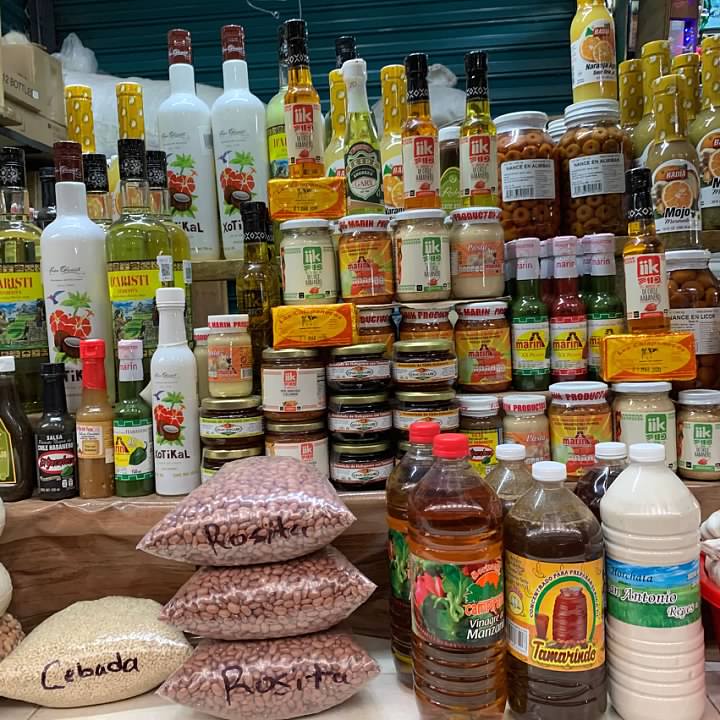
Merida Food Market. Photo by the NBP
Fish in the market. Photo by the NBP

Our food tour took us through the narrow, crowded passageways of the major food market of Merida where fruits and vegetables, honey and vanilla, spices and chiles are sold. (Another nearby market sold meat.) Food stalls were abundant, and Meridians crowded around them for lunch and snacks. Jose would stop and procure the specialties of an establishment generally not more than a few feet wide. We tried things we otherwise would not have and learned the difference between panuchos and salbutes, that turkey and venison are staples, what sopa de lima is, and that mole is not used. Instead, a black bean paste, sold in huge blocks in the market, is the base of many dishes. We went outside the market and had a terrific ceviche in a tiny restaurant followed by creatively flavored and delicious ice cream. This tour, coming at the beginning of the Yucatan sojourn, stood us in good stead for the rest of our stay as it encouraged us to eat items that we otherwise would not have understood on the menus. As we continued to eat panuchos at many places (they are similar to but different from salbutes—both are fried platforms to place other foods on, but panuchos have a black bean paste injected into them while hot), we found the food not only good and interesting, we found our drinks and meals inexpensive every place we dined.

Justice Blinded (concluded)

          Despite what “distinguished” commentators on Fox News say, an Attorney General does not work for the president. And a United States Attorney or those acting under him do not work for the Attorney General. A U.S. Attorney is nominated by the president and appointed with the advice and consent of the Senate. A U.S. Attorney pledges fealty to neither the president nor the Attorney General but to the Constitution. A U.S. Attorney serves the country, not particular people in the government.

          A U.S. Attorney can be removed but not by the Attorney General. Only the president can remove a U.S. Attorney. If a U.S. Attorney position becomes vacant, the Attorney General can appoint an interim U.S. Attorney, but that appointment only lasts for 120 days. Then the District Court where the U.S. Attorney is situated—neither the Attorney General nor the president–appoints another interim U.S. Attorney. In other words, the president cannot avoid the joint appointment power with the Senate for a long time when it comes to a U.S. Attorney.

          The Attorney General and U.S. Attorneys inhabit a strange territory filled with inconsistencies. The president can set criminal justice policies broadly or for individual cases. He can remove those who do not follow his directives, but they do not work for him. They serve the country, and he does not have the sole power to replace them. He holds that authority jointly with the Senate. It all makes sense, right, in this nearly perfect country with a nearly perfect constitution where at least someone makes perfect phone calls?

          We think our criminal justice system should be blind and impartial, and that is what we should expect of it, but the Constitution does not directly guarantee that. Even if you believe that “faithfully” executing the laws requires impartiality, you should realize that there is no constitutional mechanism to prevent a president from favoring friends other than through elections and maybe impeachment.

          Settled law does require that probable cause exists to believe that a person committed the crime in order for that person to be prosecuted for it. If that minimal standard is met, nothing in the Constitution prevents the president from going after his perceived enemies. And no matter how damning the evidence against or heinous their actions, nothing prevents the president from preventing the punishment of his friends. We can only depend on those asked to carry out such directives to thwart them. A determined, corrupt president can make that next to impossible.

          Our founders were aware of the dark side of human nature, or, as Alexander Hamilton put it, its “impulses of rage, resentment, jealousy, avarice and other irregular and violent propensities.” The framers of the Constitution created a government of checks and balance as a result, but they could not anticipate all mendacity, paranoia, and self-interest. Now that we have seen a president with a mob boss mentality who scoffs at norms of justice and integrity, we should think about how to regain those norms. If we do get out of this presidency with at least part of our democracy intact, perhaps we can find a way to enshrine blind and impartial justice into law.

Justice Blinded

          The Department of Justice overrode a sentencing recommendation by its frontline prosecutors. The defendant was the politically connected and presidential friend Roger Stone. The four prosecutors resigned from the case as a result.

          The Department of Justice (finally) said that it would not prosecute an FBI agent involved in the Russian investigation even though the president has asserted, without giving supporting evidence, that Andrew McCabe should be prosecuted.

          The Attorney General has appointed a special counsel for the confessed criminal and politically connected Michael Flynn, who is awaiting sentence. Reports indicate that other criminals who are connected to the president may be in line for preferential treatment.

          Attorney General William Barr claims that the president has never told him how to handle any case, and Barr has said that it is impossible for him to do his job when the president tweets about individual Department of Justice cases. This complaint comes as a shock since Barr may believe in one-person (probably one-man rule) at least as much as the president does.

          Trump in response tweets that he has not interfered but that he has the absolute right to order how criminal cases should be handled. He is the chief law enforcement officer, he pronounces.

          An open letter signed by almost two thousand former prosecutors and Department of Justice officials say that Barr should resign. Bill Barr has not.

          Swamp creatures are pardoned and set free. Others are pardoned whose supporters have connections with the president. And now we wait to see if the sentenced, frog-like Stone will be able to bound back to his bog without prison for his crimes against America. Ribbit. Ribbit.

          Just another week in the modern United States. It is hard to assess whether all this is a big deal or not because we have all become desensitized to Donald Trump and those around him.

          The events highlight, however, how imperfect our government is. It makes us realize that much of our sense of good government depends on norms that have been established over the decades and not on the Constitution itself. The Constitution does not prevent a president from breaking the norms of impartial justice that seem essential to a fair America and thus, does not prevent a president from moving us towards autocracy. And the events, rather predictably, also bring misleading or ignorant statements by kneejerk defenders of whatever the president does.

          More than a few “distinguished” commentators and hosts on Fox News say that William Barr must follow the president’s directions “because the Attorney General works for the president.” Another objecting to a headline from a news organization said that “Bill Barr can’t ‘intervene’ in a Department of Justice matter because the prosecutors work for the Attorney General.” Such statements, both wrong about who employs Justice Department officials, indicate how far along the path of the cult of personality we have traveled.

          Our federal government is complicated, but one thing is clear: Our chief executive is not the equivalent of the chief executive of a family business. An Attorney General and other federal officials do not work for the president. He does not pay them, and no one in the government openly pledges fealty to the president. To take office, an attorney general and other federal officials must vow: “I do solemnly swear (or affirm) that I will support and defend the Constitution of the United States against all enemies, foreign and domestic; that I will bear true faith and allegiance to the same; that I take this obligation freely, without any mental reservation or purpose of evasion; and that I will well and faithfully discharge the duties of the office. So help me God.”

          The Attorney General is supposed to work for all of us (we do pay his salary after all), not for the president alone. The lines of authority, however, are muddled. The president does have a power akin to an employer; he can remove an attorney general. Furthermore, since the president has been given the constitutional duty to “take Care the Laws be faithfully executed. . . .” he can set the priorities and policies for the Department of Justice and the Attorney General. There has been an established norm that a president should not dictate how a particular case must be handled, but the president has the constitutional authority to break that norm. Of course, if what is commanded is unconstitutional, the AG cannot–consistent with the oath of office–carry out the command, but if the directive is only unwise, the AG can be expected to be removed if she does not comply with the presidential wishes.

          The president can then seek a new attorney general, but that also is complicated. The Constitution does not give the president the power to appoint any Attorney General he wants. Instead, it says that the president “shall nominate” candidates to be federal officials, but the Constitution goes on to say, “and by and with the Advice and Consent of the Senate, shall appoint” the Attorney General and other federal officials. The appointment power is a joint one of the president and the Senate. The Constitution does not constrain the Senate in how it should use its power. It is only a norm or a convention that the Senate gives great deference to the presidential nominations. Nevertheless, the Senate has the right, for any reason it finds sufficient, to reject a particular person as Attorney General.

(Concluded February 24)

Snippets

          I went to a theater production of “Paradise Lost,” based, it claimed, on the words of John Milton. I did not think much of the play’s quality, but the group putting on the play was a Christian group. On some level they succeeded with me. Eve was not initially naked as Biblical authenticity should have required but was clothed in a filmy fabric that moved and flowed and shaped over her body. She was lovely, and well before that consequential bite of the forbidden apple, all was foreshadowed because I was thinking about ripe, luscious fruit.

          Whenever the president speaks, I keep hoping in vain for more splendid flashes of silence.

          “Silence is the unbearable repartee.” G.K. Chesterton.

          At Madison Square Garden, Hammer of the Harlem Globetrotters got us in the audience to do a wave, then a reverse wave, and finally a slow motion wave. Even though this is all a hokey cliché, I hope you, like me, can still find pleasure in the wave.

          It’s such a surprise to hear people discussing cheating in American professional sports and find out that they are not talking about Boston.

          When I looked over to see who had sat next to me at the bar, I was surprised because he seemed close to my age, and few of the patrons of this place can remember Eisenhower, much less Truman, as president. He nursed his beer and was quiet for a few moments before he pointed to the book I had placed on the counter and asked what I was reading. It was clear that he was not really interested in that but that he wanted to talk. (Note. I did not say that he wanted to converse.)

          He told me that he was a retired real estate attorney from Atlanta and had been in a big firm. He was now living in Portland, Oregon, which he and his wife had picked after exploratory vacations.

          He was in Brooklyn to visit his son, who was a freelance cinematographer after graduating from Boston College. He has given his son, he told me more than once, advice about things the son should do to be a successful freelancer. I wondered what this big-firm real estate lawyer knew about either freelancing or cinematography.

          He was not staying with his son who lived in Bed-Stuy but at a downtown Brooklyn hotel. He said, “His apartment is even too squalid for me.” I wondered what he knew of squalid.

          I said that I was leaving soon. He was quick to tell me that he was meeting his son at the bar in a few minutes and said that I would enjoy meeting him. And then he said it again. I wondered if he was uncomfortable meeting his offspring. After a few more minutes, he looked at his phone and said that his son was not coming. He left three minutes later. And I wondered whether this was as sad as it seemed.

          “The opposite of talking isn’t listening. The opposite of talking is waiting.” Fran Lebowitz.