Conscience of a Baptist (continued)

          For Williams, the progenitor of American Baptists, religion was a personal thing. A person’s conscience is God’s line of communication to the individual. Humans being imperfect might be wrong about what conscience demands, but since the conscience comes from God, it is a sin for a person to act contrary to her conscience, even a mistaken one. If I (or the state or a religious leader) forces you to act in opposition to your conscience, I am forcing you to sin, and by forcing you to sin, I am sinning.

          In other words, all must be allowed to worship as their conscience dictates, and no one should be required to worship or support religious practices against his conscience. Jesus did not force or coerce anyone to God. Man, then, can’t force anyone to faith.

          A mistaken conscience can be corrected only by persuasion, not by force or coercion. An appeal to conscience, for Williams, required the related God-given ability of reasoning. Conscience demands proof, and proof comes from intellectual rigor. Proof has to satisfy reason or be from the Bible or from a writing that convinces an individual that it was divinely inspired. Thus, Williams rejected the Quakers who were led to Christ by a movement of an ill-defined spirit within the person. Such movement did not, could not, satisfy reason.

          These views led not just to liberty of conscience and toleration on religious matters, but on all subjects. And since Jesus did not indicate that one soul mattered more than another and that all individual consciences should be respected, it meant that society should treat all equally.

          (I have refreshed my understanding of Williams’s life and teachings primarily from Roger Williams: The Church and the State by Edmund S. Morgan and Roger Williams and the Creation of the American Soul: Church, State, and the Birth of Liberty by John M. Barry.)

These Baptist precepts have led me both to my religious sensibilities as a youth and to my political thinking as an adult. The religious and the American neatly coincided. Just as people come together with God to form a church, the people of America came together to form a country—“We the People . . .” Sovereignty does not belong to the authorities, but starts with ordinary individuals. Both the church and America are founded on freedom of conscience. Religion cannot be imposed, forced, or coerced; it is the result of individual reason and persuasion. In America, a political view cannot be imposed, forced, or coerced; it is the result of an individual decision.

When I attended the Baptist church, the views of separation of church and state, liberty of conscience, equality, and religious toleration espoused by Roger Williams were strong. Tolerant Baptists may not have been publicly militant about much, but they were militant about the separation of church and state. On occasion, however, I recognized a bit of Baptist backsliding. I was home from college or law school during the Vietnam War and went to church. The minister’s sermon gave support for that war. I was offended for two reasons: (1) He was wrong about the war. (2) He was wrong as a Baptist. The church should not give or withold support for the government. It cheapened the worship of God to bring the state into it. Church and state. Separate.

I voiced my displeasure to the minister after the service, and he invited me to visit him during the week, which I did. We discussed the war. I knew that as Baptists he could not speak to me from a position of authority where he could attempt to dictate what my views should be. He, using either reason or the Bible or both, had to persuade me that his sermon was correct. He did not.

This interjection of politics into church was rare, however. Church and state were kept separate, and it was easy to predict how American Baptists would react in those days to some prominent church-state issues: prayers in public schools and government aid to parochial schools. For American Baptists the answers were a simple no and no.

The public prayers profaned God. If one prayed because the state required it, then the prayer came not out of devotion to God, but because of devotion to or fear of the state. This made such a prayer unholy and defiled true religion. If the prayer was uttered, not out of devotion and faith, but merely out of a habit, like saying “Good morning, Miss Ketter” to the teacher each morning, the prayer was still sinful.

          We American Baptists thought that the United States Supreme Court got it right when it held in 1962 that a recitation of a state-written prayer in the public schools violated the First Amendment, which prohibits an establishment of religion. Furor around the country, however, resulted. Godlessness would prevail. Communists would ascend. I found this panic amusing. My public school did not have prayers. I believe they were outlawed in Wisconsin, as they were in many–perhaps most–other states. I listened to the rants about the Court’s decision and looked about me and could not figure out what they were going on about. Wisconsin, to my keen eye that was on a vigilant lookout for such things and disappointed when I could not find them, did not seem to be more a hotbed of iniquity than the places that required public prayers. It was clear to me that there was no connection between morality or godly behavior and the recitation of prayers in public schools.

(continued June 29)
The Conscience of a Baptist (continued)

          Baptists practice adult baptism by immersion because of the Bible. The Bible is divinely inspired, Baptists believe, and the ultimate authority for leading a Christian life. Baptists find no scriptural support for infant baptism. The baptisms mentioned in the Bible, for example, of Jesus by John the Baptist and one done by Phillip, were of adults, and there is nothing to indicate that John the Baptist’s other baptisms were not of adults.

          Infant baptisms are a man-made ritual, according to Baptists, and it is not Christian to use man’s rituals over those of the Bible. And while it takes some extrapolation to conclude that immersion is required, the Bible says that Jesus and others came out of the water, and other passages do seem to support that the biblical baptism was by dunking, including the verse–I think it is in one of the Romans–that says baptism symbolizes life, death, and resurrection. Sprinkling or the thumb’s spreading of water on a forehead doesn’t really seem to be a good symbol of that.

          Baptists maintained that the only biblically-based rituals were adult baptism and the Lord’s Supper.  And on the first Sunday of every month we had communion. Little cubes of Wonder Bread and shot glasses of Welch’s Grape Juice were passed around. (As frugal as the church and its congregants were, it might not have been Welch’s, but an off brand.) I did like communion, but it brought some of my first doubts. I was told to take the Bible literally, but our church also commanded teetotaling. When I asked about why no wine, I was told that when the Bible said “wine,” it meant grape juice. Hmmm, I thought to myself.

          Adult baptism and communion and the Bible. Any other ritual or source comes from man and not God. No genuflecting. No stations of the cross. No Book of Common Prayer. No required kneeling. No incense. No icons. No required head covering. No rosary. No “mandatory” church attendance. No prayers other than to the Trinity. No saints. (It still bothers me to hear “The Gospel According to St. Mark.” No, it is the Gospel according to Mark.)

          Baptists are not only separated from other denominations by the lack of much ritual but also by the absence of an ecclesiastical hierarchy. The only kind of churches Jesus and his apostles recognized were no larger than a congregation, and Baptists maintain that is what the Christian church should still be. Nothing is above an individual church. No one imposes a minister, priest, or vicar on a Baptist church; the congregation selects its leader. No bishops; no presbytery. Each congregation is supreme.

          American Baptists did not have saints, but there was a theological progenitor—Roger Williams, the founder of Rhode Island after he was “asked” to leave Puritan Massachusetts. He established the first American Baptist church in Providence. Williams should be considered one of our most important Founding Fathers, but he seems to be almost unknown today. When I used to walk by the Roger Williams Hotel on Madison and 31st Street in Manhattan, I wondered how many of my fellow passersby had any idea who Roger Williams was. The hotel was built on land leased from the neighboring Baptist church, and, I once heard, was owned by the American Baptist Church. Times change. The hotel was sold, and now has what seems like a brand-tested name, The Roger.

          Williams was a remarkable man. Unlike many of his American contemporaries of the early seventeenth century, he treated the Indians with respect and produced a primer of the complex Algonquian language. (Bill Bryson in Made in America: An Informal History of the English Language states that this work “is a feat of scholarship deserving of far wider fame, incidentally.”) But Williams should be better known because so much of his thought, expressed in his voluminous writings, broke from conventional thinking and was the foundation for many of the bedrock principles of this country—sovereignty in the people, equality of people, liberty of individual conscience, and separation of church and state.

          Williams made the radical argument for his time that governments were not divinely inspired. Nowhere in the Bible does Jesus pick a government or endow rulers with authority. Instead, Williams contended, sovereignty is with the people. Just as people come together and join with God to form a church and then pick its ministers, the people come together to form a government and grant authority to the rulers.

          This led Williams to reject the common notion of his time that the state must enforce God’s laws to prevent religious errors. Instead, since the state gets its powers from the people, government is invested with all the errors of the people. Any attempt to enforce religion by the state will always be error-filled and will, in essence, be an attempt for people to have sovereignty over God. Thus, long before Jefferson, Williams called for a “wall of separation” between church and state, a wall he called for to protect not the state, but religion. He believed that religion always suffered when it was protected or required by the state. For Williams, the church is sheltered by spiritual weapons and harmed by government efforts to enforce religion. God makes Christians, not a government. When religion and politics are mixed, the result is not true religion, but politics.

(continued June 26)

The Conscience of a Baptist

          I was raised in Wisconsin. I was raised a Baptist. To many these would seem incompatible statements. They think of Baptists in Georgia or Alabama or Texas. They think of Southern Baptists, but there are many varieties of Baptists in this country.

My childhood church was part of the American Baptist Convention, which now has the name American Baptist Churches. (Earlier it was Northern Baptists.) Our affiliation came from the mother’s side of the family, which had roots in upstate New York. If you drive through New York State or New England, you can see hundreds of little frame buildings, invariably white, neat, and small, at crossroads or byways that are American Baptist churches. These northeastern churches always remind me of the First Baptist Church in Sheboygan, Wisconsin, which was also small and white. Our church building did not have to be spacious because the congregation was not large. I doubt that the pews ever held anywhere near 100 people at a time.

I have not paid enough attention to the New York churches to know whether they invariably have a belfry, but to me our building seemed especially like a church because hanging in those upper reaches was a real bell. When a boy in this First Baptist church got to be twelve, he would be put on the roster to ring the bell at the beginning of the services. (Back then, I never wondered why girls were not bell ringers.) 

I loved ringing the bell. At the appointed time, I would walk upstairs at the rear of the church to the balcony, which was always free of parishioners. A ladder went from the balcony through a small opening to the belfry. A rope hung from the bell to the floor. We had been instructed on how to ring the bell. The first strike must not be tentative; it had to sound as full-throated as any of the other rings. This meant grabbing the rope as high as possible. I would get on my tiptoes and pull as hard as humanly possible to the floor so that the bell would swing as far is it could and the clapper would hit the bell firmly.

To me it was always a thrilling sound to hear that first strike correctly executed. And just as that first strike had to be full on, the last strike had to be as firm as any other and then silence. We were not to allow any ding, ding, ding trailing off. This required halting the bell’s swinging by getting an extra firm grip on the rope and then holding the rope at the floor as the last striking occurred. And thus the first prayer of the day: “Don’t let the rope slip out of my hand. Don’t let the bell pull me off the floor. Don’t let the bell pull my shoulders out of joint. Don’t let my feet slip.”

With the bell successfully stopped, it had to be carefully returned, through good rope management, to its neutral position where it stayed for another week. Job done. Having felt as if I had called the service to order, I descended the ladder and the stairs to take a seat in a pew. Sometimes as I got to a seat, an adult, almost always a man, would give me a nod, which I took to mean, “Well done.”

That ringing bell was the most flamboyant part of the service. Think about all those jokes you might have heard about the taciturnity of a New England farmer. Our church descended from those roots.  We had a simple service with little ceremony or pomp. Yes, there was hymn singing, a responsive reading, readings from the Bible, and a sermon. I wouldn’t say that it was joyless, but it was staid. I was surprised when I went to church with a high school girlfriend. (Ok, not the hottest date of my life.) The Methodist minister said something that was meant to be amusing during his sermon (it was mildly amusing at best in any other context than a sermon), and some congregants sort of laughed. I realized that in my church, I had never heard a chuckle during the service, much less a laugh.

          What most people know about Baptists is that they practice adult, not infantile (ok, infant), baptism, and baptism not by merely sprinkling of water but by full immersion of the believer into water. The definition of an adult for baptism, it turns out, may be a bit loose. I was baptized when I was twelve or fourteen. But apparently old enough to profess that I was willing to accept Jesus as my savior.

          Our church, as with many if not all Baptist churches, had a place near the pulpit for the baptisms, but it was different from what others may consider a baptismal. It had to hold enough water to dunk a six-footer. Ours was about the size of a hot tub, but without the heaters or the air of decadence. It, of course, was plumbed so it could be filled with water and then drained. Those of us being baptized changed out of our Sunday finery into something that could survive being soaked. When my time came, I got into the water that came up to my waist. I was surprised by the minister, who was wearing fishing waders that were not visible to the congregation. He supported my back and head. I leaned backwards until I was under the water, and then he lifted my sputtering body upright and said that this symbolized death and resurrection and a new life in God. And, so, at least for those moments, I was saved.

(continued June 24)

Snippets

There is talk about a baby boom because of the shelter-at-home mandates of the last three months—call them Covid-19 babies although I hope that none are ever named “Covid.” But I wonder how many were conceived in the first fortnight and how many in the last few weeks after partners had spent months continually together.

“Ezra watched spellbound, eyes bright and jaw slack; he could never get enough of humanity, so long as it slept in another room.” Lisa Halliday, Asymmetry.

Those of us who are sports fans have heard the National Anthem countless times at stadiums and arenas and on broadcasts, but in the last few months we may have not heard it at all. Without the usual doses of the “Star-Spangled Banner” have we become less patriotic or is that ritualistic singing irrelevant in having a love of America? Perhaps it might be a good thing if, because of the pandemic, we reassessed the connection between sports and patriotism, but we still have the controversy over athletes kneeling during the National Anthem. This action has been labeled by the Golfer-in-Chief as “disrespectful to the flag.” The kneelers, whether they are correct or not in their assessments, seek to make the United States a better country. Wanting a better country implies not disdain, but love for the nation. However, if you believe that it somehow undermines the country to silently kneel during the National Anthem, then you should be happy that with sports cancelled or postponed the country has not been so undermined during this period. Do you feel that the country is stronger as a result? This makes me wonder. I have never attended a professional golf tournament. Does each session begin with the National Anthem? Since the golfers begin their rounds at different times and spectators seek different vantage points around the course, it would not make much sense. If golf does not have the National Anthem for all participants and spectators, may I assume that those at a golf event are less patriotic than those at a football game?  And, does Trump stand and sing the National Anthem—assuming he knows the words—before he plops down in a golf cart for his frequent eighteen holes?

“Conventionality is not morality. Self-righteousness is not religion.” Charlotte Bronte, Jane Eyre.

“It is what it is.” I want to retire this phrase. The spouse does not. Yet again, the spouse is winning.

What is the name for the cardboard tube inside a roll of toilet paper?

The spouse asked me what time I wanted to leave to be on time for our restaurant reservation. I answered. She immediately said she wanted to go five minutes earlier, and it was clear that we were going at her preferred time. As I started to ask why she asked me what time I wanted to go, I, of course, knew the answer. If by happenstance I had stated the time when she wanted to go—the time when we would go–she could look like she was merely acquiescing to my wishes. Smart or manipulative?

Are you a zen master if, when you order a hot dog, you say, “Make me one with everything?”

Piecing It Together

Version:1.0 StartHTML:000000203 EndHTML:000054777 StartFragment:000009263 EndFragment:000054745 StartSelection:000009263 EndSelection:000054745 SourceURL:https://ajsdad.blog/piecing-it-together/ Piecing It Together – AJ’s Dad

AJ’s Dad

AJ’s DadSkip to content

Search for:

Piecing It Together

A guest blog from the spouse.

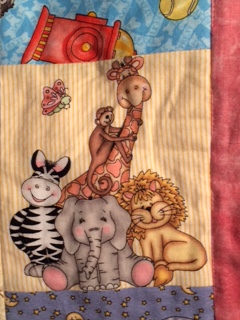
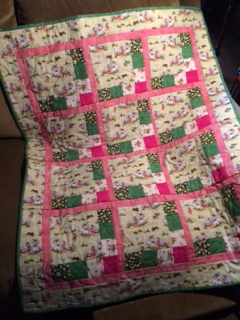
I’m not certain when I started making baby quilts. It was probably when our friends from college started having babies. I thought my first one was truly amazing, and I was inordinately proud of it. Looking back on the photo of it now, it was a simple affair, but colorful and vaguely competent. It wasn’t “quilted” (stitched from front to back through the sandwiched batting), nor was it “bound” (having a neat binding around the outside). That was long before the days of the Internet, so who knew from “quilting” and “binding”?  

I picked it up again when my students, post-docs and younger colleagues started having babies. There came a time when four of them were due within weeks of each other (my colleague was having twins), and I made five quilts for a joint baby shower! – none of them was quilted or bound. Somewhere along the way (thank you, Internet), I learned how to do both. However, no matter how many times I watched YouTube videos on binding (and I had to re-watch one every single time I made a quilt), it took me well into my tenth quilt to get it right. In short, I’m not much of a seamstress, but there is something satisfying about making a baby quilt even when it is imperfect.

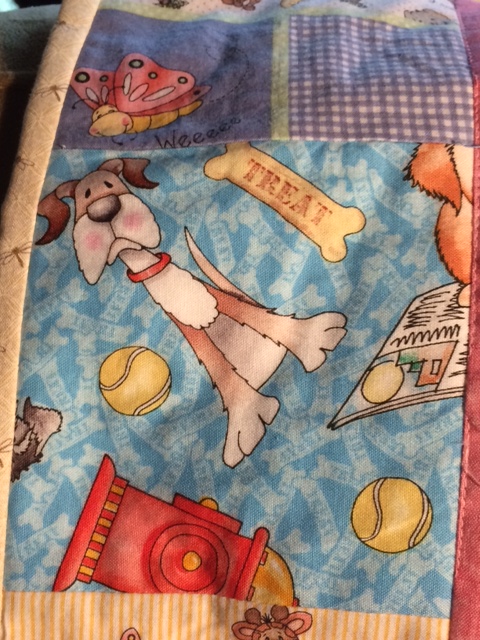
Why? One starts by picking out the fabric. Fabric designed for babies is comforting. It’s routinely made with lovely, soft pastels or bright, cheerful primary colors. There are tiny flowers, idyllic scenes, or slightly goofing-looking animals. These animals peek around corners, cluster in goofy groupings, smile, and look for all the world as though they would like to play with you. What’s not to like?

Then there are the designs one can make: Stars, pinwheels, bright patterns of color. One can also clip out those precious little animals, highlight them, build a structure around them. But what needs to emerge from that structure is a crisp rectangle even if the animal clip-outs are of different sizes. It’s a challenge in measuring, piecing, measuring again, adding a piece here, a square there. One designs one’s own puzzle.

I volunteer with an organization that collects day-old flowers from grocery stores and florists, freshens them up and assembles them into small bouquets that are then distributed to residents of nursing homes and women’s shelters. On the day of assembling, there may be as many as thirty or thirty-five different kinds of flowers available for the bouquets. Volunteers fuss over their little creations, but the truth is there is no need for fussing; a bouquet of flowers is simply pretty. There is no way to make a mistake.

Making a baby quilt is similar. There are a hundred ways to make a mistake, of course, but given basic competence, the result of the piecing and measuring and assembling, the colorful fabrics, the animal smiles, even the jumble of pieces almost always make a satisfying bouquet.

The NBP (non-binary progeny) and I are also into a different kind of puzzle-making – jigsaw puzzles. When the NBP was just a little tyke, they liked puzzles, and liked creating fantastic cities from Legos — a different kind of puzzle. As they got older, they became adept at putting together complicated three-dimensional puzzles of The Eiffel Tower, Big Ben, The Capitol.

This interest lapsed only to re-emerge in adulthood. After my retirement, the puzzle craze took hold of us both. They and I are particularly fond of Ravensburger puzzles with 1000 pieces. The puzzles are quirky, colorful, filled with phantasmagorical figures, mysterious black and white photographs, whimsical structures, dreamscapes, exotic flowers and books, always many books. Tiny pink shmoo-like beings hide out in nooks and crannies. The puzzles are a joy to assemble. We have assembled, disassembled, and re-assembled at least seven of them.

These assembling exercises have become essential to us during the recent stay-at-home orders caused by the Covid-19 pandemic. But thank goodness for babies! In the past year, four of the NBP’s friends, two of my dear friend’s daughters, and a past student of mine are about to have or have had babies.  I have been busy all year making quilts, but I have made three since March…labors of love and labors that have a visible product, a reason for the exercise, and, frankly, a reason to get up in the morning.

So: quilting in the morning and jigsaw puzzling in the afternoon. The NBP and I have sat in companionable silence for at least two hours a day working on a completely useless product that has given us both calm satisfaction. We have completed four puzzles, the hardest one was a polar bear mother and cub in snow. The NBP did most of it; I found it difficult indeed…and truly not that much fun. I know now why Inuits have 100+ words for white!

One of my friends says that I must enjoy putting things together. I hadn’t thought of it that way, but in times when the world seems to be unraveling at a frightening pace, maybe putting these things together has been an unconscious effort to gain some control over what feels like a chaotic present and an uncertain future.

Could you kindly let me know if you or one of your friends or relatives is about to give birth? I could use another baby to swaddle.

Share this:

Like this:

LikeLoading…https://widgets.wp.com/likes/index.html?ver=20190321#blog_id=122270492&post_id=1641&origin=ameliasdadblog.wordpress.com&obj_id=122270492-1641-5eea138502c76&domain=ajsdad.blogEdit

Text Widget

This is a text widget, which allows you to add text or HTML to your sidebar. You can use them to display text, links, images, HTML, or a combination of these. Edit them in the Widget section of the Customizer.

Search

Search for: Blog at WordPress.com.

Post toAJ’s DadCancel

https://widgets.wp.com/likes/master.html?ver=20190321#ver=20190321%d bloggers like this: Skip to toolbar

  • Notificationshttps://widgets.wp.com/notifications/?v=@automattic/jetpack-blocks@13.1.0-5015-gd57f427480&locale=en#https://ajsdad.blog/piecing-it-together/
  • Me
  • Write

Log Out

:)

The U.S. Fort Named for the Bumbling Traitor

          I just watched Wanda Sykes’s Not Normal on Netflix. It was taped more than a year ago, but it was timely as she urged that we confront present and past racism. She recounts that when she returns to Virginia she sees off the interstate “a big, giant Confederate flag. Every time I go home and I pass that flag, it hurts me to my core. It fucking hurts. ‘Cause it’s racist. It’s racist and it’s wrong. And I’m sick of this bullshit of ‘Well, that’s part of my Southern heritage.’ Well, your heritage is shitty. It’s garbage. Your heritage is trash. The atrocities that happened under that flag, are you proud of that shit? – Yeah. – What the fuck? There are so many other things about the South that you can be proud of. Right? Moonshine. Dollywood. Come on. You got to love Dolly Parton and Dollywood. Clay Aiken. Come on. Why don’t you tear down those statues and put up a statue of Clay Aiken drinking moonshine, wearing a Dollywood t-shirt.”

          Maybe, just maybe, Sykes is seeing some progress. A statue of Jefferson Davis, for example, was torn down in Richmond, Virginia. Such a de-pedestalization has not been uncommon in the past few years, but it is remarkable that NASCAR—yes, NASCAR, with its deep Southern good-ole-boy roots— recently banned the Confederate flag, something that could not have been predicted even a few months ago. I was surprised even further when the Secretary of the Army and the Secretary of Defense both said that they were open to the renaming of at least ten military installations honoring Confederate soldiers. On the other hand, I was not surprised when the Tweeter-in-Chief, apparently blindsiding the Pentagon leaders, slammed the gates on that possibility: “My Administration will not even consider the renaming of these Magnificent and Fabled Military Installations. Our history as the Greatest Nation in the World will not be tampered with. Respect our Military!” Our history, Mr. President, undermines our “Greatest Nation” status.

          This military controversy did teach me something. I had not known that some of our army installations were named for Confederate soldiers. Curious, I did an intensive, twenty-minute internet research, and I found that Ft. Bragg in North Carolina honors Braxton Bragg. He fought for the United States in the Seminole Wars and the Mexican War, but, although he opposed secession, he was a Confederate General in the Civil War.

          I don’t know how the North Carolina fort came to be named after Bragg other than that he was born in that state, but I assume that it came at a time when many in the South maintained that the Civil War was not truly about slavery and that instead it was about states’ rights — that it was the War Between the States or the War of Northern Aggression. This wishful propaganda, of course, was revisionist history. Perhaps we might explore this further another time, but let us not doubt that the South’s core purpose in seceding was to preserve slavery. Historians have demonstrated this time and again. All Americans should be offended by the honoring of those who fought and killed to maintain the enslavement of Americans.

          In addition, it is remarkable that we would honor those who were traitors and committed treason. For example, wouldn’t you be offended to have a statute of Benedict Arnold in your town square? “Benedict Arnold” became synonymous with “traitor” shortly after the American General Arnold defected to the British during our Revolution. We would never erect a monument to that traitor. But Arnold, before his switch, was an American hero and had a major role in the battles around Saratoga and Lake Champlain that helped secure our independence. Benedict Arnold does have a sort-of memorial at Saratoga—a sculptured pair of boots (Arnold was wounded in the leg there) with an inscription that mentions a “brilliant soldier” without giving Arnold’s name. This, however, commemorates his bravery fighting for the new United States. We don’t have memorials commemorating his time battling for the British against the United States for the simple reason that we don’t honor Americans who fought against the United States. Unless, that is, they fought against the United States from 1861 to 1865.

Many of us have not recognized Confederate soldiers as traitors and treasonous, but we should. They made war on the United States. The constitutional Framers carefully defined “treason”: “Treason against the United States, shall consist only in levying War against them, or in adhering to their Enemies, giving them Aid or Comfort.” The Confederacy levied war against the United States. Confederate leaders knew they could be charged with treason if they lost the war, just as Revolutionary leaders expected Great Britain to hold them treasonous if the War for Independence failed.

A major issue after the Civil War was whether to charge the leaders of the Confederacy with the constitutional crime of treason. Jefferson Davis was so charged, but he was never tried. United States officials concluded that the desired reconciliation of the country would be harmed by treason trials, and on Christmas of 1868, President Andrew Johnson issued a “pardon and amnesty” for treason to “every person who directly or indirectly participated in the late insurrection or rebellion.” A result of Johnson’s proclamation is that we don’t see the Stonewall Jacksons and the Robert E. Lees as traitors, but, of course, they were. And if we saw them as traitors, we might wonder more about why there are so many memorials to them. If Braxton Bragg had been tried for treason, I can’t imagine that we would have a military installation named after him.

We should not honor anyone who fought for slavery and against the United States, but there is another curious thing about honoring Bragg. He was a terrible general. The noted Civil War historian James MacPherson puts Bragg in the “bumbler” category. One summary states: “Bragg is generally considered among the worst generals of the Civil War. Most of the battles in which he engaged ended in defeat. . . . Bragg has a generally poor reputation with historians. . . . The losses which Bragg suffered are cited as principal factors in the ultimate defeat of the Confederacy.” Even in his day the Confederate General was detested: “Bragg was extremely unpopular with both the men and the officers of his command, who criticized him for numerous perceived faults, including poor battlefield strategy, a quick temper, and overzealous discipline.” Jefferson Davis recognized Bragg’s flaws and relieved him of command.

Why would we honor someone who fought to maintain slavery, was a traitor, and was a bad and unpopular military leader? The only answer might be that it is because he was so inept, and Braxton Bragg thus helped the United States to win the Civil War. Surely that is a curious reason, to say the least, to have a Ft. Bragg.

Snippets

During these shelter at home days, the spouse has made many baby quilts. In other words, she has been quilting. She and the NBP have put together difficult jigsaw puzzles. In other words, they have been putting together jigsaw puzzles. Don’t we a need new a verb here?

“The test of a vocation is the love of the drudgery it involves.” Logan Persall Smith.

I have seen discussions of who Joe Biden should pick as his vice-presidential running mate. The lists, however, never include my choice: Beyoncé. She would bring a lot to the ticket. She could appeal to many ethnic and racial groups besides blacks since her Creole mother has a diverse ancestry including French, Spanish, Chinese, and Jewish. Beyoncé was born in Houston and perhaps could help make Texas into a swing state. She might even appeal to Republicans of a certain age since she gave birth to twins in the Ronald Reagan UCLA Medical Center. She has been financially successful without having been given millions from her Daddy. She has been placed on the lists for the most influential people in the world and Time’s person of the year. She has supported Democratic candidates, the Black Lives Matter movement, LGBTQ rights, and has identified as a feminist. No, she has not been elected to any office but that did not matter in the last election. She is, however, an amazing artist and a successful businessperson, founding a company and a co-owner of at least one other. And, as far as I know, neither her companies nor she have ever declared bankruptcy. Beyoncé: Think about it. However, I do not know if she will reveal her tax returns.

“There is, of course, no reason for the existence of the male sex except that sometimes one needs help with moving the piano.” Rebecca West.

I was taught that holding the Bible upside down, as someone recently did, is what witches did to summon the Devil.

“If you set off on a witch-hunt, you will find a witch.” Chinelo Okparanta, Under the Udala Trees.

Once again the cry for law and order. As throughout history, many who demand law and order do believe in order.

“Among those who dislike oppression are many who like to oppress. Napoleon

The local news source’s headline read: “A Homophobe Has The Strongest Chance At Winning Bronx’s 15th Congressional District Seat. But Others May Come Out On Top.” I thought that the second sentence should read: “Others May Come From Behind.”

Questions for the Fourth of July, or Any Day

The summer community’s Fourth of July traditions have included an ahistorical “Paul Revere” ride through the streets at daybreak; fireworks one night, a communal picnic another; and a small parade that leads to the swimming pool where people plop and populate the hills for a ceremony that has included the singing of songs; children reciting the names of the signers of the Declaration of Independence; the release of thirteen doves (pigeons?); an address from a community resident. All attendees pin on a badge with the year that person first came to the community. During the ceremony attendees are asked to indicate whether they have an ancestor who signed the Declaration of Independence, and a surprising number of people stand.

In anticipation of the Fourth, a community group prepared a questionnaire expecting that the tabulated results would be presented at the July celebration. It asked not only the ancestor-signing and when-did-you-come-here questions but also whether residents had met their significant others in the community; whether respondents had gone to the summer camp held annually here; and other questions of a similar sort. Since the community was founded by Philadelphia Quakers, residents were asked whether they or their ancestors were Friends. And a question asked whether community members had ancestors on the Mayflower. Although the questionnaire was written in January, it only went out last week. Many residents have responded without comment, but a few people objected that in this time of Covid-19, peaceful protests, and riots, the survey was tone deaf by focusing on a white American heritage.

I was surprised, and a bit pleased, that some questioned the questionnaire. The community prides itself as an oasis of tranquility and civility, which is frequently remarked upon. Less often do we reflect on the fact that we come from a privileged, narrow slice of society. Primarily this a community of second homes, and second homes signify affluence. Wealth is seldom overtly flaunted here, but there are no working class people. We have heads of companies, but no one who works on the factory floor. Dues are high and property prices are higher than in the surrounding area. You need more money than most people have in this country to live here.

And the community is overwhelmingly white. In my three decades here, there have always been a smattering of Asians, but the black and brown residents have never comprised more than the fingers on one hand.

I do believe that the Fourth of July should be a day to celebrate our independence, but it should be more. We should recognize that the Founders, like all humans, were flawed, and we should go beyond just a consideration of Jefferson, Adams, and Franklin. The day should also commemorate America, American history, and all Americans. It is a time for patriotism, but we should stress that the true patriot wants not only to protect the country but to make it better. And we should recognize that throughout our history, from colonial times until today, this country has struggled with race and class issues that have not been resolved. We are not a perfect union, and all patriotic Americans should think about how to make it better.

          Such ruminations got me thinking about questions I might like to ask of my fellow residents of this privileged, white summer community, questions that I, too, should ask of myself. For example:

Have you ever eaten dinner in the home of someone who was non-white? How often have you entertained a non-white in your home? How often have you entertained more than one non-white person or couple at the same time? What percentage of your neighbors at your primary residence would you estimate are non-white? Have you ever looked for a place to live in a neighborhood where the majority were non-whites?

How many of your neighbors are not in the top echelons of wealth? How much income do you think that it takes to lead a middle class life?

Have any of your bosses been non-white? What percentage of your co-workers at roughly your level are non-white?

Did any of your ancestors hold the opinion that Italians or Jews were not white? Were any of your ancestors concerned about the “Yellow Peril”? Did any of your ancestors oppose independence? Did your ancestors own slaves? Did any of your ancestors support abolition? Did any of your ancestors, or you, support or oppose any the civil rights movements throughout our history? Did your ancestors in this country face discrimination or racial, ethnic, or gender slurs? Have you faced discrimination or racial, ethnic, or gender slurs?

Are people less American if their ancestors were not here in 1776? Have you had a DNA test to find out more about your ancestry? Why? What reactions did you have to the results?

Have you ever taken part in a protest rally? How often and what for? How often have you been arrested? How often have you had in an encounter with the police where you felt afraid? How often have the police injured you? Have you ever been stopped and frisked? Have you ever been tear-gassed or pepper-sprayed? Have you ever been followed around in a store by security personnel?

What was your reaction when the Black Lives Matter movement emerged? Did you object when Colin Kaepernick and other athletes “took a knee” during the playing of the National Anthem?

Do you have ideas about how to bring more non-whites into this community? How do you think your neighbors would react if there were more non-whites here?

Do or did your children go to public schools, religious schools, or private schools? How many of their classmates are non-white? How many are in the lower half of income. What kind of schools did you go to?

Do you have any relatives in law enforcement? How would you feel if a child of yours said they wanted to be a police officer?

And a question that I feel I should regularly confront: In what ways would you say you are most hypocritical about race, class, and law enforcement issues?

A Sausage Made It Famous (concluded)

Just as there were many Sheboygan butcher shops in my youth making bratwurst, there were many neighborhood bakers making semmel, the rolls for the brats. Each butcher had his own blend of spices and secrets for making the pork sausages, and everybody maintained that their source produced the tastiest brats. My friends and I thought the bratwurst we ate were the best, but since I almost always ate bratwurst at home, as my friends did, we did not really have a base of knowledge for our bragging. We all just assumed that our moms bought the best.

Aside from festivals—oh, I will get to that—I remember eating bratwurst not bought at our local butcher twice. Johnny M. asked me to go to a Milwaukee Braves game with his parents. They may have thought that would be a treat for me, but since I was so shy around adults, it was torture. Mrs. M. had packed food featuring cold bratwurst. I thought that gross, perhaps even worse than mayonnaise on them. I had eaten leftover brats many times, but ours were always heated in the pot with beer.

          The family did get an irresistible bratwurst yearning sometimes when it was not Sunday and we were not geared up for our own grilling. The answer was to go to a little hole-in-the-wall restaurant on a commercial street, the Come On Inn. It had three or four counter stools and a perpetual charcoal fire. They may have had something besides bratwurst, but that is all I remember. We would get brats to take home, the only takeout we ever got. I don’t believe the Come On Inn got their brats from our butcher, but they tasted good.

          I do know, however, that all brats were not the same. At least one butcher made a beef brat so the Jewish population could participate in the Sheboygan tradition. It comes as a surprise to my New York friends that this little town in the Midwest had synagogues, but about ten percent of my school classes had Jewish children. (Jackie Mason, yes, that Jackie Mason was born in Sheboygan, but I believe he left at a young age.) In my circles, we were all friends no matter what the religion. I went to some bar mitzvahs, but that does not mean that we understood much about Judaism except that every so often the Jewish kids were not in school because of some holiday not known to the rest of us. I ran for president of the high school, and Barry Goodstein was my campaign manager. (His personal slogan was, “The only Goodstein is a full one.”) I won. (I wanted to win but only for the glory not the job and was a terrible president.) My mother, who really wanted me to be senior class president because that person gave a speech at the high school graduation and she could then gloat at the ceremony about her son, wanted to celebrate my election. We invited Barry. We, of course, served bratwurst, but we had no idea that he could not eat our brats. Instead, after ours were cooked, Barry scraped and scoured our grill and cooked sausages he had brought. We felt awkward.

          While the butchers might have produced slightly different sausages from each other, I never heard any discussion of which bakery made the best semmel. They were regarded the same no matter which of the many bakeries they came from. The mother bought the bratwurst; the father bought the rolls on the Sunday mornings. The father brought the siblings and me to Sunday School at our church at nine o’clock and picked us up afterwards. He went to the bakery. He did not then go home, but to his local bar. You might have to be a Sheboyganite to understand the joys of a tavern at nine on a Sunday morning. (Perhaps another time I will tell you about the time when I was home from college or law school and the father and I got more than a little tipsy playing pool at Dick’s Club while having draft beers and shots of brandy on a Sunday morning. It was a bonding moment as we tried to hide our state from the mother as we ate bratwurst when we went home.)

          I grew up with bratwurst. So did everyone in Sheboygan. Sheboygan was famous for bratwurst. Throughout the state in those days when there were no national purveyors of the sausage, restaurants would advertise that they were serving authentic Sheboygan bratwurst. The local movers and shakers (not my family) thought the town should capitalize on its fame, and the Jaycees, when I was eight, started Bratwurst Day. The festivities were centered downtown at Fountain Park. Not surprisingly, that block-square park had a fountain. It also had a band shell and bubblers—of course, you know what those are; if not, ask a Wisconsinite of a certain age—and a spigot for “mineral water,” regarded by some as healthy. People would fill up jugs to take home. The water tasted to me as if it had been stored in a rusted cast iron pot for several winters and then unwashed socks were dunked in it.

          I don’t know what Bratwurst Day is like now. It has been more than fifty years for me, but I gather it caused a bit of a brouhaha when professionals entered the brat-eating contest to grab the $1,000 prize. Perhaps still now, but back then, the Miss Sheboygan contest was held on that day. She may have been crowned Miss Sheboygan, but it was hard not to call her Miss Bratwurst. Make what jokes that you will.

          In my youth, bratwurst was a local thing, but now, of course, bratwurst can be found just about anywhere, often under the Johnsonville brand. Johnsonville is a village in Sheboygan County about fifteen miles from the great metropolis. The Johnsonville company, located there, does not play up the Sheboygan connection. No one I knew growing up ate Johnsonville brats. They weren’t authentic Sheboygan bratwurst.

A Sausage Made It Famous (continued)

A sausage other than summer sausage truly defines Sheboygan. As the signs say when you drive into the city: “Bratwurst Capital of the World.” At a time when few in the country knew what bratwurst was, everybody in Sheboygan ate it. Our family certainly did. It was our Sunday dinner, eaten midday, at least every other weekend. Cooking it was the father’s job. It was always grilled over charcoal, never cooked in the stove or a frying pan. The father built a grill in the backyard beyond the detached garage. He poured a foundation, laid bricks in a rectangle to waist height with a door in front to scoop out ashes, placed iron bars for a grill, and then, for reasons unbeknownst to me, added over the  back of the grill a chimney that went to six feet. All this was for bratwurst. Chicken, pork chops, and T-bones were cooked in the kitchen, and those steaks and chops were always, always well done. The grill was a monument to bratwurst, which in Sheboygan was well understood.

The grill, however, had a problem. That chimney did not draw well. Instead of accepting the smoke, it often expelled it forward into the face of the father. He was a great problem-solver with physical objects, and he made modification after modification, but the chimney won out.

That lack of drawing power also made it hard sometimes to light the charcoal. He did not use lighter fluid. The father regarded that as dangerous, but perhaps more important, lighter fluid, he thought, could impart a residual taste to the bratwurst. Instead, he started the fire with wood kindling, and when the contraption was not drawing well, he could have some problems. It took awhile to get the briquettes (who knew from lump charcoal back then?) to the desired white ashy state.

When I said we had bratwurst at least every other week growing up in Sheboygan, Wisconsin, I did not mean just in good weather. We had brats cooked on the father’s grill even in the dead of winter. The father bundled up against the cold, pulled on over-the-shoe galoshes (we didn’t say boots) closed with buckles and carried out the sausages, a pot with an inch of beer in the bottom that was placed at the back of the grill into which the cooked bratwurst were dropped to keep them warm until the rest were completely done—no underdone pork in this household—and water for flareups. Flareups were common when a sausage casing was pierced and fat—oh, yes, those brats had fat—dripped onto the coals. Flames shooting up were quickly followed by various imprecations and oaths from the father. (I worked with casings at the butcher shop. A large bucket in the walk-in refrigerator held a tangled bucket of guts in a brine. I would tug and unravel one strand until I found its starting point. I then attached it to a faucet and ran water through the intestine, or whatever it was, until liquid squirted out. I then cut the casing before and after the hole. I carefully arranged the section that I had proofed and attached the new end to the faucet and began again. Plunging my hands into forty-degree, heavily salted water made them cold, puckered, and almost unusable for hours afterwards, but I suppose I can boast that in a little way I have been a bratwurst maker.)

The brats my father cooked were eaten inside a semmel, a hard, crusty roll with a soft interior (think Kaiser roll) with an indentation down the middle that made it easy to divide it. Double brat = whole semmel. Single brat = half. The rolls were warmed in an oven while the brats cooked. We put ketchup on the sandwich. A few Sheboyganites used mustard. Onions, cooked or raw, and pickles could be placed on top of the bratwurst. I don’t ever remember tomatoes or lettuce.

Notice no mention of mayonnaise. On the not-yet-spouse’s first visit to the ancestral home, bratwurst was presented. She in ignorance asked for mayonnaise. Dead silence for two reasons. The family could not imagine mayo with bratwurst; it was too heretical for us even to imagine. (Perhaps akin to someone in New York wanting mayonnaise on a pastrami sandwich.) And we did not own mayonnaise. On many sandwiches we spread butter. (Good radishes placed between slices of bread slathered with butter was, and continues to be, a favorite. Gabrielle Hamilton sometimes had radishes and butter on her Prune menu. I like to think that I beat her to that delight.) After a lengthy pause, the not-yet-spouse was offered Miracle Whip, which was in our tiny refrigerator but almost never used, and she looked as if she were going to gag. I don’t remember how she ate her bratwurst.

(concluded June 8)