Snippets

“I wouldn’t mind paying taxes, if I knew they were going to a friendly country.” Dick Gregory.

President Biden is a disappointment. He has visited scenes of natural disasters and not once flicked out rolls of paper towels.

How old do you have to be to understand why I was taught to squeeze the toothpaste tube only from the bottom?

I am wondering when Florida or some other state will ban reruns of “Star Trek.” Tony Horwitz in Confederates in the Attic: Dispatches from the Unfinished Civil War (1998) reports that some white supremacists protested the show because to them, Mr. Spock—half human, half-Vulcan—was a coded promoter of miscegenation.

A story in a Jimmy Carter biography that I hope is true: Carter had said that he followed what his parents taught him, and he would never tell a lie. A reporter interviewed Jimmy’s mother and asked whether it was true that the Carters told no lies. Miss Lillian replied, “Maybe a little white one.” Asked for an example, Miss Lillian continued, “Remember how when you walked in here, I told you how sweet and pretty you were?”

Some people have tact and others tell the truth.

We had made it to the open sky after ascending the steep, slippery, worn, damp stairs. We were wet from the plunge in the cave’s pool, a cenote. At the picnic table next to us, two women were also toweling off. One then began putting on suntan lotion. I said that if she were planning to go into another cenote a few hundred meters away, that was mistake since she would just have to wash it off. To keep the waters in cenotes uncontaminated, swimmers must shower off lotions, perfumes, deodorants, and the like before going into the water. Even though you might think of Yucatan as a warm place, the cenote showers are colder than any mixed drinks I had there. I learned that the women were from the Netherlands. I asked to see their thumbs. They looked puzzled. I said that I heard that the Dutch all had large thumbs to plug holes in the dikes. This is a witticism I invariably drop when meeting someone from Holland because it invariably amuses me and no one else. One was a nurse and the other a social worker. They worked together in a drug addiction clinic for 18–24-year-olds. Even in the civilized Netherlands addiction destroys lives. It was sad that they said that fentanyl was becoming an increasing problem.

A boss a while back was being interviewed on television. He said that, of course, no one actually made the median salary. Yet another reason, I thought, to get out of the job I was in.

An elderly woman at the pharmacy was deciding which of her drugs she should take home because she could not afford them all. I felt very sadly American as the scene unfolded.

A few years back an observer said, “Our forefathers objected to taxation without representation. Now we would be glad to get taxation without misrepresentation.”
Sunrise Over Chichen Itza

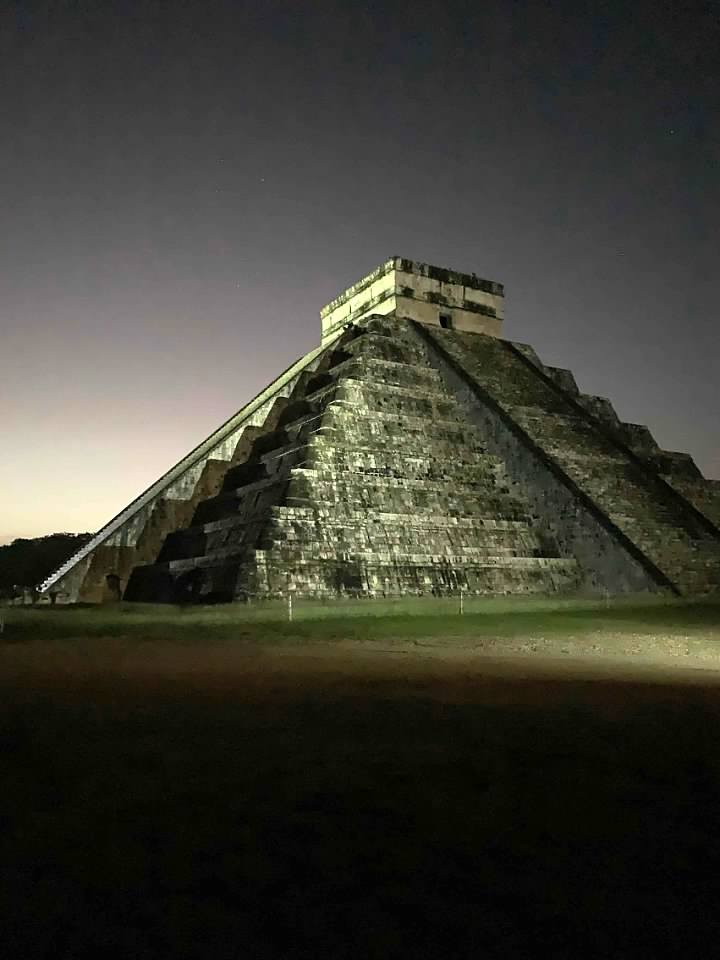
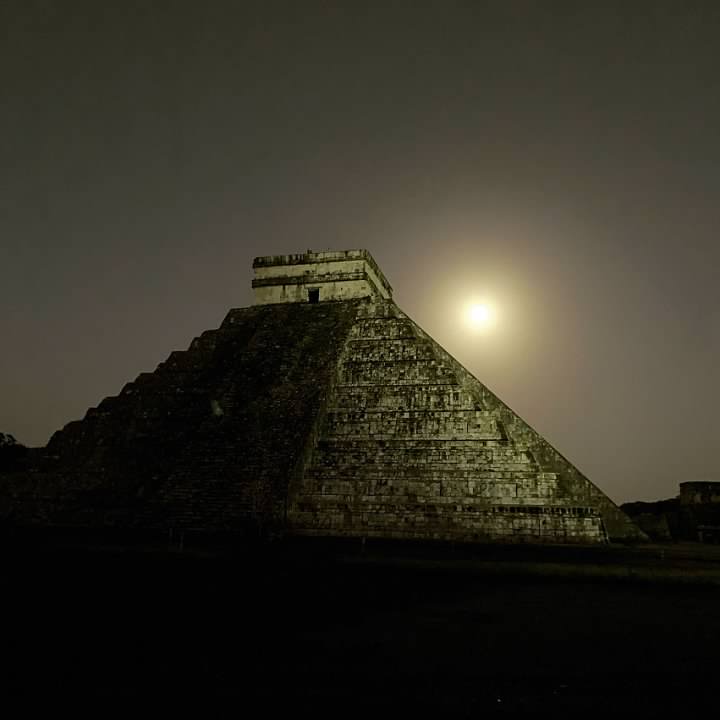
On a recent trip, we entered Chichen Itza, the most famous Mayan ruins in Yucatan, at 5 A.M. We were there to watch the sun rise over the famous pyramid and other structures. It was still dark in the east, but it was not completely dark. A full moon hung low in the west, giving a lovely glow to the setting. However, it was dim enough for our guide to hold a light pointing at the edge of the pyramid to mimic the sun’s rise at the equinox. The head of a serpent’s head is carved at the bottom of the structure’s steps, and the shadow cast by the guide’s light, and by the sun at the change of the seasons, resembles the lengthy body of a serpent culminating at the carved head. The Mayans knew the placement of the heavenly objects, and the pyramid was carefully constructed to commemorate the snake the Mayans revered.

The Snake. Photo by the BNP.

As the moon set, its light was replaced by a purplish tint to the eastern clouds. Then the rim of the sun pushed its way up from the surrounding jungle. I hadn’t liked getting up in the dark, but this magic was worth it.

Sunrise over the Pyramid. Photo by the BNP.

After the sun rose, our guide, who was necessary for the early morning entry, showed us around the main ruins. The spouse and I immediately recognized a change from our other visit forty years ago—visitors were no longer permitted to climb up the pyramid’s steps as we had once done. We had even walked through an opening and entered the inside of the pyramid, which is really the outer pyramid of a Russian doll nest of structure upon structure built over centuries. Unknown then was the fact that underneath the entire structure is a cenote, an underground freshwater lake.

Even back then we were amazed that clambering over the pyramid was permitted, thinking that thousands going up and down and entering it had to do it harm. We also felt a danger. Climbing up the hundred feet was hard enough, but when I got to the top and looked down, the heart beat faster and sphincters tightened. The steps are steep and narrow, less wide than the length of my foot. It looked more like going down a ten-story ladder than descending steps.  I paused and looked unavailingly to find another way down, but there were only the treacherous steps. I proceeded cautiously, sort of sideways, one slow step at a time, but then as I was crabbing my way downwards, I looked about me and saw teen-age Mexican girls, dressed as if for a date, scampering up and down in high heels. Even so, my deliberate, frightened pace did not increase.

The pyramid dominates the Chichen Itza landscape, but the ball court and chak mool (chakmool, chak-mool) are photographed nearly as much. The main ball court has two parallel walls with a viewing area above. A ring is attached high on the wall. The teams competed by passing a hard, heavy (nine pound) rubber ball through the ring without the use of implements or hands—a hip bump was used to propel the ball. The ring is high, above head height, and I could not imagine ever being able to score.

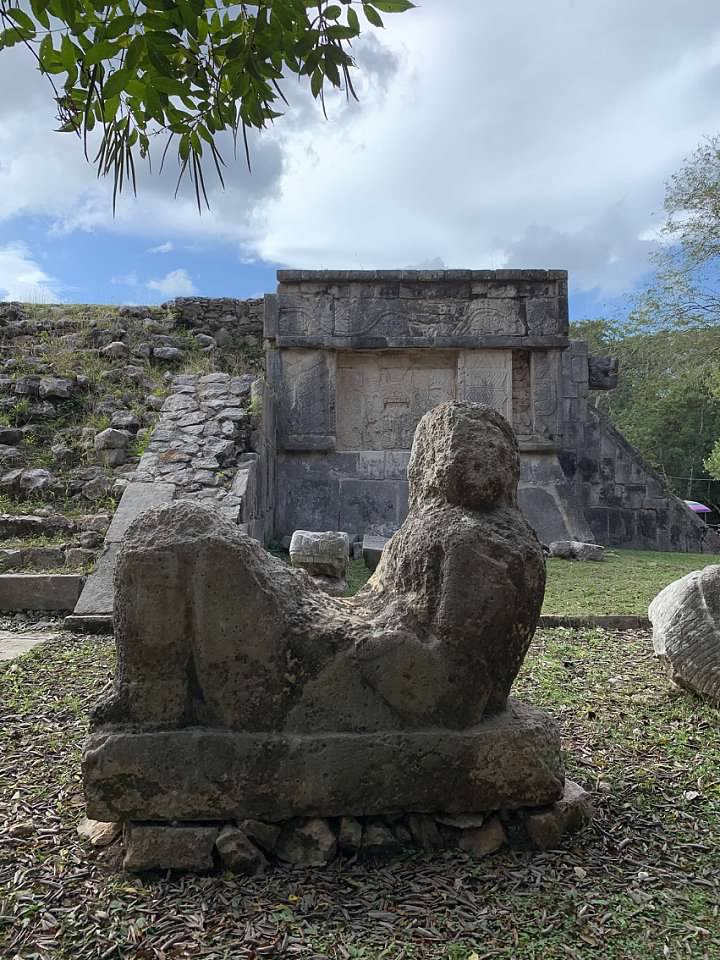
Chak mool is a statue of a reclining man leaning on his elbows with the head turned ninety degrees, I think always to the right. A plate or bowl is on the stomach of the man. And just as Chichen Itza has more than one ball court, it contains several chak mool statues.

Chak Mool. Photo by BNP.

The ball court and chak mool are linked together by human sacrifices.

(concluded 3/16)