“It’s a hard rain’s a-gonna fall”

I stumbled on Martin Scorsese’s early Bob Dylan documentary. Then I saw last year’s movie about the singer, “A Complete Unknown.” These experiences had me thinking about the first time I saw Bob Dylan perform live. I had just started college.

I have no ability to perform music. I cannot carry a tune. I don’t play an instrument. Even so, I have always enjoyed music. My earliest musical exposures were limited. Music did not exactly saturate my early childhood home. We did not have a hi-fi or any kind of record player. The local station to which our radio was tuned had eclectic programming from Don McNeill’s Breakfast Club to Paul Harvey and only sometimes played music. Instead, a lot of my musical knowledge came from television variety shows, which, befitting their name, had a wide variety of musical acts.

Glen, my best friend in grade school, also shaped my musical tastes. Unlike me, he was a musician. He would tell me about new songs he had liked and when and where I could find them on the radio because some stations played the same song every day at a similar time. And thus, among many others, I learned about Jody Reynolds and “Endless Sleep,” a teenaged schlock song that still today can get stuck in my head.

I spent more time in cars as I got older. If a teenager was driving, the radio was inevitably tuned to the top forty station, WOKY, which was pronounced by the DJs to rhyme with its hometown, Milwaukee. (We could get a learner’s permit six months before our sixteenth birthday, and the goal was to pass the driver’s test and get a license on the sixteenth birthday. These were full licenses. Our driving was not limited in geography or to the time of day.) This was the beginning of rock n’ roll. Top forty radio was not just trite and tired music. New songs and new sounds seemed to come weekly. I, and many others my age, fell in love with the innovative music of Elvis, Buddy Holly, the Everley Brothers, the Beach Boys, and on and on. (I first heard Presley when in the car with my father. He was appalled. I knew the world had changed.)

I thought that I had a respectable grounding in modern music, but then I went to college. One of my three freshman roommates came with a collection of records, some of which were by artists unknown to me. There was Josh White, (“You gets no bread with one meatball” still carousels through my head some days.) There was the much different jazzy sound of Lambert, Hendricks, & Ross. There were many others but the most surprising was Bob Dylan, whose songs were not on any radio I listened to. I was fascinated by the lyrics he sang (“And I drove down 42nd Street/In my Cadillac. Good car to drive after a war.”).

College, of course, is a time for new experiences, including music. A new experience was the social life. I was at a non-coed school. For days, maybe sometimes weeks, I hadno interchanges with anyone of the female persuasion, and when one occurred it was usually not with someone of a comparable age. However, on “big” weekends, girls (I did not consider myself a man, and I did not think of them as “women”) came for the weekend. Families in town rented out rooms for the dates, but the girls were allowed in our rooms up to a point. I don’t remember what the regular hours were, but on those big weekends, girls could be in the dorms until midnight. Upperclassman had a place to be at that bewitching hour. They were in clubs where partying went on until three or four o’clock, but freshmen were not club members and would have nothing to do once twelve o’clock struck. To avoid this, the university had midnight concerts, and to my surprise then and now, in November 1963, Bob Dylan was booked.

I don’t have the novelistic ability to capture the bizarreness. The calendar said it was the 60s, and Dylan helped define that time. But while perhaps what we now think of the 60s may have been emerging in the Greenwich Village that helped spawn Dylan, that new decade had not yet hit most of the country. Certainly it had not come to the central New Jersey, Ivy League campus filled with conformist boys who wanted to take their place with bankers and bankers’ lawyers and doctors with upscale practices.

I only knew of Dylan because my roommate had owned The Freewheelin’ Bob Dylan. A large portion of the audience had never heard of him. They were there, many slightly to extremely drunk (even though underage, no one stopped our campus drinking), because there was nowhere else to go. There was a stark contrast between the Ivy League audience dressed as preppies and preppy wannabes and Dylan, still in his acoustic stage, with his entourage dressed in jeans and leather vests and bandanas and motorcycle caps and cowboy hats. Many were shocked not only by his wardrobe but by his singing.

Dylan just introduced his songs and sang and made no comment about the audience. I still wonder what Dylan was thinking about while performing for us. But my admiration for Dylan increased that night.
Road Trip–Fallingwater Edition (continued)

          Except for the lack of choices of nearby restaurants, the Hartzell House was a model bed and breakfast. Our spectacular room and bath had been designed with a wheelchair in mind, so the spouse in particular loved the easy walk-in shower. The rest of the house had a comfortable dining room, great food, welcoming public rooms for reading or chatting with other guests. The guests we met were pleasant. One couple from Rochester were going on to Louisville to see friends and then return to Pittsburgh for a few days. Their trip was a short one for them—ten days. They told us they took frequent six-week trips to Europe.

          Another couple, Dick and Barbara, were from Vermont. Both were retired—he as an engineer in a small aeronautics firm and she as a middle school math teacher. They were now snowbirds wending their way south to their home on Florida’s west coast. They had been to a wedding in Philadelphia, and after our B and B, they were off to see relatives (and racetracks) in Lexington, Kentucky. Dick, however, was most looking forward to three days in Memphis where they planned to visit Graceland. The seventy-seven-year-old said that he listened regularly to Elvis while driving. We all exchanged stories about when we had first seen or heard Presley, and I pulled up on my iPad Elvis’s first appearance on the Ed Sullivan show, which Dick, the spouse, and I watched together.

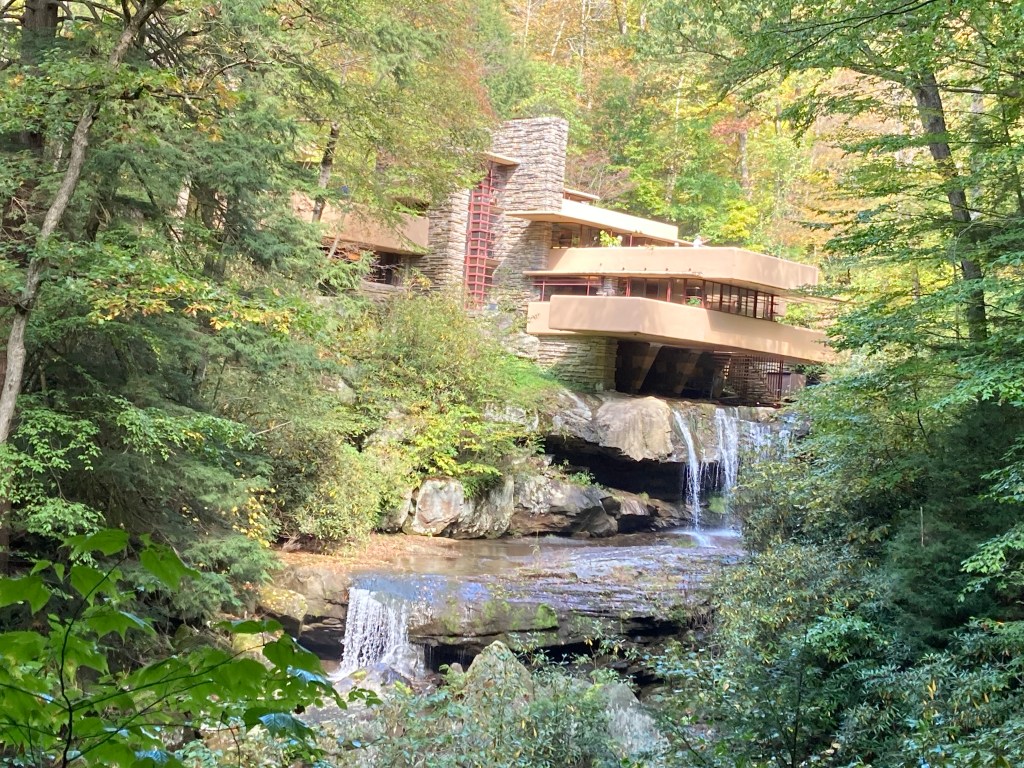
          All of us were at the inn to see Fallingwater, the Frank Lloyd Wright–designed house, famous for its horizontal, cantilevered construction situated over a small waterfall. The house, built in the late 1930s, was commissioned by Liliane and Edgar Kaufmann, the owner of Pittsburgh’s Kaufmann’s Department Store. They used it for weekends until their deaths. Ownership then passed to their son who, in 1963, donated it to the Western Pennsylvania Conservancy, which opened it and its grounds to the public the next year.

          A reservation for a tour is required to see the house, and this is one time when Covid worked to our advantage. Before the pandemic, tours of fourteen were scheduled every six minutes. Now the departures are every twelve minutes with no more than eight in a group. The house did not feel crowded, and the viewing was leisurely, which must not have been true previously.

          The house, of course, is a marvel, but while I liked aspects of it, overall it did not appeal. The main house has low ceilings, which, I guess, are meant to force attention to the outdoors, but it did the opposite for me, giving a cramped feeling. I felt separated from nature in the house, not a part of it. The house has built-in furniture with lines that mimic the exterior but rarely seem inviting. A good house for me has to have good places to read, and this house failed that basic need. However, I did like the beautifully crafted built-in desks, and I would have moved into the separate guest wing–complete with creek-fed plunge pool–in an instant.

Taken by the Spouse
By the Spouse, again

          I have toured other Wright-designed buildings. Fallingwater brought back memories of the Robie House in Chicago, which was built much earlier. The Robie House also has horizontal lines that tend to make me feel squinched (a technical word) and has built-in furniture that echo the lines of the house, furniture that is stylish but not welcoming. The spouse articulated part of what I was feeling when she said, “Wright houses are creepy.” But I am glad that I saw it. It was worth the effort.

          Fallingwater also made me think of Ayn Rand and The Fountainhead. In it she created Howard Roark, an architect, who embodies a version of Rand’s ideal–a man of independence and integrity. The novel’s plot is bad soap opera; the writing is often embarrassing; but I found it to be a page-turner. The book was published only a few years after Fallingwater was built, and Frank Lloyd Wright has been seen as an inspiration for Howard Roark. However, Wright indicates why Rand’s “philosophy” is on the same level of philosophic insights found in a D.C. Comic. (In a New Yorker cartoon, a farmer and son stand in a cornfield with the stalks holding The Fountainhead and Atlas Shrugged. The father says, “If they are reading Ayn Rand, they aren’t mature.”) Wright might have been a creative genius and strong-willed, but as Fallingwater indicates, he was not a truly independent man, and his artistic integrity had to be adaptable.

          An architect needs money to build the envisioned masterpiece, and that requires a patron. Wright needed Edgar Kaufmann, and as our guide made clear, Kaufmann vetoed some of Wright’s ideas and insisted that other details be included. Wright fought for what he wanted, but some of the time he had to yield unless he simply wanted to walk away from the project, which, obviously, he did not do. Apparently, the real-life architect was not an island unto himself.

          An exhibition in the Speyer Gallery, part of Fallingwater’s Visitors’ Center, also brought the “independent” man to mind. It displayed marvelous drawings by Joseph Urban, the Viennese-born architect, illustrator, and scenic designer. In 1928, Edgar Kaufmann asked Urban for Urban’s vision of how to redesign the main floor of Kaufmann’s Department store. The drawings, beautiful and meticulous, showed a dramatic Art Deco space, and I thought of going to Pittsburgh to see what Urban created. But at the end of the exhibit, I learned that Urban did not get the commission; Kaufmann picked someone else for the redesign. A patron may give the “independent” man leeway, but if you need a patron, you are not truly independent.

          Even so, some people read Ayn Rand as if she held a key to the universe. And there are other reasons to feel a sense of despair.

(To be continued.)