The Assimilation of the Scum of Southern Europe (concluded from Sept. 26)

When considering our present immigration policies, it is useful to examine the history of Italian immigration in this country.  

Immigration from Italy to the United States soared at the beginning of the twentieth century. From 1900 to 1905, the numbers increased from 171,735 to 479,349. Between 1880 and 1921, 4.2 million Italians, most from southern Italy, entered the country. Many Americans thought this flood of immigrants was harmful. The 1911 Eleventh Edition of the Encyclopedia Brittanica entry on immigration, seemingly referring to all those Neapolitans, Calabrians, and Sicilians, put it delicately: “The influx of millions of persons of different nationalities, often of a foreign language and generally of the lower classes, would seem to be a danger to the homogeneity of a community. The United States, for instance, has felt some inconvenience from constant addition of foreigners to its electorate and population.” Though citing no reference, the essay goes on, “The foreign-born are more numerously represented among the criminal, defective and dependent classes than their numerical strength would justify. They also tend to segregate more or less, especially in large cities.”

Almost none of the Italian immigrants — largely illiterate rural peasants who professed a religion that was still not considered acceptable by many Americans — spoke English. Many made little effort to learn it. These Italian immigrants, 75% of whom were male, did not plan to become Americans. As the Britannica put it: “It is notorious that the Italians who emigrate to the United States largely return.” Aristide Zolberg reports that while roughly 35% of all immigrants to the United States from1908-1923 returned to their homelands, more than 50% of Italians did. Other estimates of returnees are as high as 78%. (These “birds of passage”—young Italian men who migrated alone, earned money, and returned to Italy—have regularly popped up in histories, novels, and memoirs. For example, a character in Agatha Christie’s Murder on the Orient Express is a man born in Italy who had been a cabdriver in Chicago and, after saving money, moved back to Italy. Daphne Phelps in her charming A House in Sicily refers to “a diminutive Sicilian barber who had spent nine years in New York before returning with his savings.”)

Thus, the arriving Italians did not appear to contribute much to the American economy. After all, they were destitute upon entry. A 1902 report said arrivals at Ellis Island from southern Italy came with the least amount of savings of any immigrant group, $8.67. They worked and saved, but not to invest or spend it in America. They sent or took their savings back to Italy.

In addition, many Americans believed about southern Italy what the Encyclopedia Brittanica said: “Countries sometimes aid or assist immigration, including the assisted emigration of paupers, criminals or persons in the effort to get rid of undesirable members of the community.” (That Eleventh Edition also contains this rather discomfiting statement: “Finally, we have the expulsion of Jews from Russia as an example of the effort of a community to get rid of an element which has made itself obnoxious to the local sentiment.”)

Certainly, the Italian arrivals seemed dangerous. Michael Dash reports in The First Family: Terror, Extortion, Murder, and the Birth of the American Mafia, “Nineteen Italians in every twenty of those passing through Ellis Island were found to be carrying weapons, either knives or revolvers, and there was nothing in American law to stop them from taking this arsenal into the city. The Sicilian police were said to be issuing passports to known murderers to get them out of the country.”

Even if the issuing of such passports was untrue (Dash does make clear that the many of the founders of the American mafia fled Sicily after convictions or charges for murder and other crimes), the American populace was led to believe that Italian criminality was rampant in the U.S. The sensational American press of the time played up murders and other crimes committed by Italians in New York and New Orleans and focused on the killing in Sicily of New York police lieutenant Joseph Petrosino, who was seeking Italian criminal records of Italians living in the United States. Not surprisingly, the 1903 New York Herald gave this warning: “The boot [of Italy] unloads its criminals upon the United States. Statistics prove that the scum of southern Europe is dumped at the nation’s door in rapacious, conscienceless, lawbreaking hordes.”

Many American citizens believed that Italian immigrants should never be naturalized. This led to the question, “Are Italians white?”, an issue discussed in many places including by Isabel Wilkerson in Caste: The Origins of Our Discontent (2020), and by Paul Morland in The Human Tide: How Population Shaped the Modern World (2019). One of my favorite meditations on the topic is in the must-see movie Sorry to Bother You. The film’s characters are discussing how blacks make pasta differently from whites and how it should be made. In an attempt to end the discussion, the protagonist states that spaghetti is Italian. Another character incredulously asks, “Italians are white?” “Yes.” “For how long?” The protagonist replies, “For about sixty years.”

The whiteness of Italians was an issue because of our naturalization law, which in 1790 allowed only free white persons to become citizens. This was slightly modified in 1870 to allow the naturalization of former enslaved people, but otherwise a person in the early twentieth had to be white to become a naturalized citizen. (“White” was not defined, and this restriction led to some bizarre court cases. In 1923 the Supreme Court ruled that a high caste Sikh, who pointed out that his ethnicity was Aryan and who had fought for the United States in World War I, was neither white nor black and could not be naturalized. A Court of Appeals case in 1915, however, ruled that a Syrian could become an American citizen.)

Instead of grappling with the issue of Italian whiteness, Congress, concerned about the Italian influx and the immigration from eastern Europe, changed the law to make it harder to immigrate to the U.S. from “undesirable” places. After this 1924 act, Italian immigration dropped from 283,000 in 1914 to 15,000.

And the moral? The Italian immigrants, seen by many as lawless, destitute, illiterate thugs who could not speak English and did not try to learn it, who were a danger to the American fabric and a drain on the economy, and who smelled bad because they ate — God help us! — garlic, are now as American as an American can be. When we discuss immigration today, we should remember this history. As the Eleventh Edition of the Encyclopedia Britannic said about the difficulties for the host country from immigration, “Nevertheless, the process of assimilation goes on with great rapidity.”
The Assimilation of the Scum of Southern Europe

Stump speeches, social media, and ads by politicians announce without supporting evidence that countries including Venezuela and some in Africa are emptying their prisons and mental hospitals and sending the inmates over our southern border into the United States. Of course, rapists and other criminals, the same sources maintain, have been coming over that border for years. On the other hand, these migrants must not be full-time criminals because they take jobs away from Americans, especially “Black jobs.” And these border crashers fuel our fentanyl crisis.

This makes little sense. People don’t cross deserts and evade armed U.S. agents and circumvent walls to commit random rapes and murders, and I have not seen evidence that illegal aliens have come to rob banks or pursue the kinds of crimes done at the likes of Goldman Sachs. They have come as laborers expecting to do hard menial work. They hope to send money back to their families. They want to stay out of trouble so as not to be jailed or deported. Not surprisingly, study after study has concluded that the undocumented commit serious crimes at a lesser rate than American citizens and that documented aliens commit those crimes at a much lesser rate than our citizenry.

If the undocumented come to work, then it seems to follow that they must be taking jobs from Americans. On the other hand, the undocumented are not in a position to negotiate for higher pay or better working conditions, and it is often said that these immigrants do the jobs that Americans won’t take. Of course, if you believe in the law of supply and demand and free enterprise, Americans should take the jobs if pay and working conditions are improved sufficiently. At some price point–$25 per hour or perhaps $40 per hour–American citizens should be willing to pick lettuce, and perhaps even kale, slaughter chickens, plant bushes, and hang drywall. If all the undocumented are deported, as one presidential candidate vows, we will have to change our immigration laws to let workers back in legally or the costs of many goods and services will increase.

And “securing” the border is unlikely to significantly affect the flow of fentanyl into this country. Many people may successfully cross our southern border illegally, but many get stopped. If those apprehended had been carrying significant amounts of fentanyl, this information would have been trumpeted so loudly on Fox News and the New York Post that it would not have escaped our attention. And yet, the apprehension of those drug couriers has not made much news. Perhaps, just perhaps, that is because not much fentanyl enters the country that way. Imagine that you were importing fentanyl into this country. Would you have it come in via backpacks carried by those crossing the border illegally? The apprehension rate for the undocumented has gone from 50% ten years ago to 70% in 2021. In other words, the odds are strong that even if the carrier makes it to the border, the drugs will not make it into the country. And then, of course, you have to find a good way to offload those drugs from the mule, which can be an iffy business.

Meanwhile, many, many vehicles cross the southern border legally. Fentanyl does not take up much space. There are many ways to hide the drug in vehicles. And it is easy to arrange for delivery once the drug-laden car or truck or plane makes it into the U.S.

Border patrol officials maintain that 90% of the fentanyl that enters from Mexico comes in at legal crossings. Furthermore, most apprehended couriers are American citizens, which, of course, makes sense. If you were running the drug smuggling operation, wouldn’t you think that a Mexican or Honduran would be more likely stopped and searched at the border than an American citizen? “Securing” the border, if that means stopping illegal crossings, will do little to change our fentanyl crisis. And, of course, as long as there is a demand for the product, those laws of supply and demand mean someone will find a way to bring the opioid into the country.

If you continue to maintain that the “Biden/Harris border policies” are a major cause of the overdoses, consider this fact: The fentanyl deaths doubled during the Trump years, and the rate of increase since then has lessened. If Biden is to be blamed, then more blame should be heaped on his predecessor.

The widespread hysteria over undocumented immigrants, however, does not seem to be about all of the undocumented. We mostly fear those brown people who cross the southern border. There are many others, often of the lighter persuasions, who are living in this country without proper authorization. They have often come legally, as students or tourists, for example, and stayed in the United States instead of returning to their homeland at the proper time. I have met such people from Ukraine, Germany, Belgium, Poland, and, of course, Ireland. Aristide R. Zolberg, in his book, A Nation by Design: Immigration Policy in the Fashioning of America (2008), states that while the notion of “illegal immigrants” may evoke images of Mexicans and Central Americans, many Irish working in construction and child care—perhaps as many as 100,000—are here illegally. When we were looking for nannies to help with our newly-arrived child, we were advised to advertise in the Irish Echo, and to do so in such a way as to indicate we would not be asking to see a green card. Years later, I asked our contractor, who had assimilated so well as to lose almost all his brogue, when he came to the country. He gave a date. I smiled and jokingly asked, but when did you come legally? The spouse shouted that I couldn’t ask such a thing. Sean only smiled and gave a time several years later. (No matter how well you can sing “Come Out Ye Black and Tans” or know the music of The Pogues or praise Jimmy Ferguson, don’t go into a Bronx bar filled with ruddy faces and start talking about immigration or citizenship.)

However, whatever we do to secure our southern border and whatever we do to remove the undocumented from the country, we will continue to have “foreigners” among us. The classic Eleventh Edition of the Encyclopedia Brittanica of 1911 stated what is still a truism: “Migration in general may be described as a natural function of social development. It has taken place at all times and in the greatest variety of circumstances. It has been tribal, national, class and individual. Its causes have been political, economic, religious, or mere love of adventure.” As long as conditions are harsh in other lands and America beacons as a better place to live, some will find a way to enter this country. (For the history of our copy of the EB, see the posts of August 1 and 3, 2022, Rule Encyclopedia Brittanica—Eleventh Edition.)

And just as assuredly, a portion of our populace will see danger from this migration. If you have an Italian ancestor, or a friend or relative does, or perhaps if you just like pizza, pasta, or a latte (Italian, meaning you paid too much for the coffee)–that is, just about everyone–and you are concerned about immigration now, you should reflect on some of our history.

(concluded October 1)

Rule Encyclopedia Britannica–Eleventh Edition

I don’t regularly read the Eleventh Edition of the Encyclopedia Britannica that we rescued decades ago. But it’s more useable now that the spouse has rebound it.It is overwhelming. Each of the twenty-nine volumes averages about 1,000 pages with entries I would not even think of looking up—“Hydrasine,” for example, is followed by “Hydrate,” which precedes about 180,000 words and scores of illustrations, charts, and equations on “Hydraulics.” But in its new state, I do consult this Britannica more often than I did before.

I thought it might be interesting to see what the learned books had to say about some important topics today. I looked up “Ukraine” and found but five lines telling me that it was a former name for a district of European Russia and that the “portion east of the Dnieper became Russian in 1686 and the portion west of that river in 1793.” That nearly-empty-cupboard entry perhaps tells me something of significance for today’s conflict, but I don’t know what. (On the same page, six times more space was given to “Uist, North and South,” which I had never heard of. Okay, I will tell you that they are islands in the Outer Hebrides, with a population then of about 5,000, apparently swelled sometimes by anglers.)

I then went to “Filibuster.” The brief entry first traced the word’s origin from Dutch through French and Spanish, where it became a term for pirate. It went on to say that in nineteenth century America it came to mean adventurers who organized expeditions in the United States to take part in revolutions in Central America and the West Indies. It concluded: “From this has sprung the modern usage of the word to imply one who engages in private, unauthorized and irregular warfare against any state. In the United States it colloquially applied to legislators who practice obstruction.” I did not learn–as I had hoped–the 1910 view about how congressional filibusters originated or their usefulness.

More satisfying, however, have been entries about places I plan to visit. We have booked an autumn trip to Rochester, New York. I appreciated getting some information about the city’s early history. I had no idea about the dramatic river cutting through the town. I wonder whether the landmark buildings the entry described will still be there, but it reminded me of some of the famous and important people who lived in Rochester in the nineteenth century. After reading the entry, I became even more eager for the trip.

The encyclopedia’s entry on Iceland was less enlightening because I had already visited and read books about the country when I looked it up. The topographical, geological, and historical discussions added little to what I had already seen or heard about. What was most surprising about the entry, however, was that more than half of it was devoted to the literature of Iceland, centering on ancient texts in an opinionated, authoritative tone. (“Taste has sunk since the old days, but still this rimur poetry is popular and genuine.”) But since I am interested in modern writing, the descriptions of what seems to be hundreds of ancient works held little interest for me.

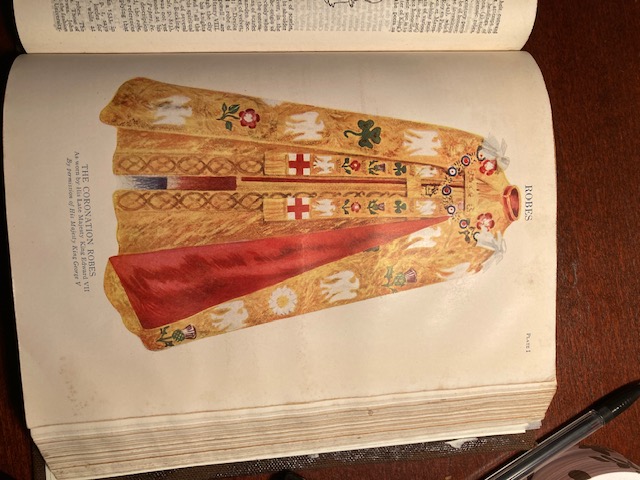
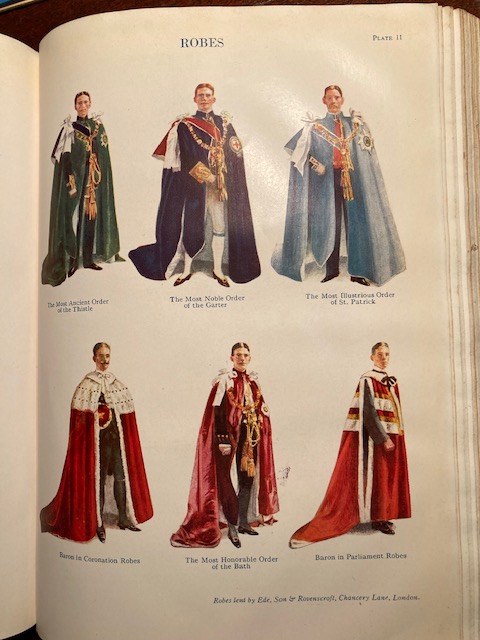
Perhaps the most joy that the set has given me are the serendipitous discoveries when I search for something and my eye is drawn to an illustration. When I looked for Rochester, I saw five color plates accompanying “Robes,” and I (temporarily) learned that the garment for The Most Ancient Order of the Thistle is green with black and white accents and a long, golden braided cord hanging from the neck. (I also incidentally learned, again temporarily, that there is [or was] such a thing as The Most Ancient Order of the Thistle.)

Coronation Robe
Robes

Black and white photographs make me move on to “Round Towers,” and I learn for the moment that a “peculiar class of round tower exists in Ireland.” My search for Ukraine is interrupted by eight color plates of “Uniforms.” I can see how “France: Sergeant Alsace Regt: 1690,” “Ludhian Sikhs,” Prussian Generals, and many more were attired.

Uniforms

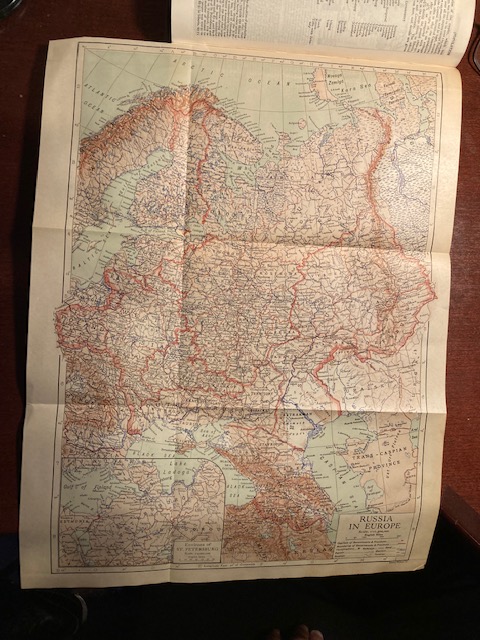
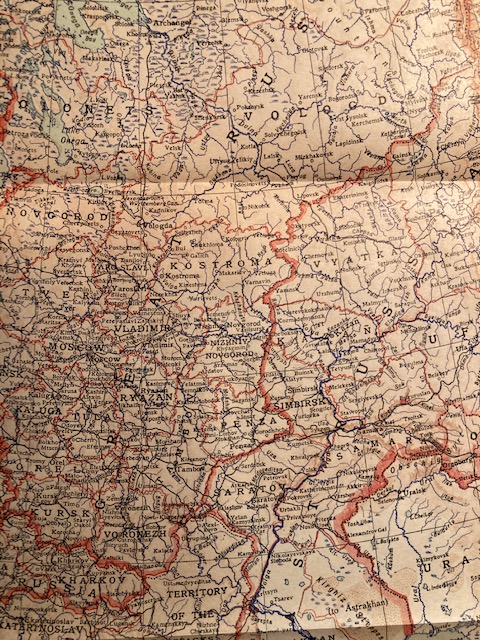
The most striking feature in the encyclopedia are its maps. Every volume has several, usually in color, that fold out to fifteen by twelve inches. The “Hus-Ita” book has foldouts for maps for Idaho and Montana, Illinois, two for India (Northern and Southern parts), Indiana, Iowa (but in black and white), and Ireland. The detail is incredible and serious examination requires a magnifier. (In a square inch of the Ireland map, I spot at least thirty-five labels.) They are maps, but also works of art. They are well preserved in the set. I feel a strong temptation to razor them out, mount them, and then add onto the house so that I can have a map room, but there are so many exquisite ones, it would have to be a somewhat large addition.

Map: Russia in Europe
Detail: Russia in Europe

I am grateful that the spouse rebound our long-possessed 1910 Encyclopedia Britannica, for while I doubt that it will be an everyday occurrence, I expect that I will dip into it more often now than I have in the past. And if you perhaps would like to know an early twentieth century viewpoint on something, let me know. As always, my research fees are reasonable.

Rule Encyclopedia Britannica–Eleventh Edition

I spotted them spilling out of a small dumpster in front of the store’s window. This was fifty years ago, and I was on Fourth Avenue in lower Manhattan. On and around the seven blocks of Fourth Avenue from Astor Place to 14th Street had been what was called “Book Row,” New York City’s used-book district. The heyday for this book center had been the 1940s and 1950s, and by the time I came to New York City, many of the stores were gone, but a sizeable number had hung on.

The Fourth Avenue bookstores called to me because of a cherished day. I had finished law school and was living in New York City where I had been working for a while. The college alumni magazine had published a list of books, in effect a syllabus, for studying the American revolution. Most of the books had been published a decade or more earlier. My recent reading had been largely aimless; I had never taken a course on the Revolution; and I thought that it could be interesting to read as many of the books on the list as possible. In those ancient days, you could not simply go online to order the books; you had to physically find them. I had set the next Saturday for my book hunting, but a winter storm hit with seventeen inches of snow stopping at four on Saturday morning. Being then young and full of vim and vigor (what is vim?), I decided to carry out my self-appointed task despite the storm. Many streets were yet to be plowed, and many walks were uncleared, but the local subway was running.

          I got to Manhattan’s Sixth Avenue and Eighth Street and started walking east. The sky was a brilliant winter blue. A nippy wind made everyone’s cheeks rosy but tramping through the drifts and mounds of still-pristine snow kept me warm. Without traffic, it was quiet, and we few pedestrians treated each other reverentially as if we were the deepest friends on a meditative retreat. It was the kind of day where I was thrilled that there was a winter and I was in it.

A few wonderful bookstores still existed on Eighth Street, and I stopped in each of them, but my real destination was Fourth Avenue. Most of the Fourth Avenue stores had a loose organizational layout at best. I might find a handwritten sign on a bookcase that read “US History” to aid my search. The shelves had no apparent organization, and I would have to scan all the volumes to see if there were any on my list. The stores, it turned out, had a surprising number of them, and every time I found one, I got a bit excited as if I had found something much more than an out-of-print book. I had found instead some sort of little treasure that could only be found after an effortful search—the kind of thrill a seeker does not now get on the internet.

And I got another little thrill that day eighteen months after my Revolutionary expedition. I had spotted several sets of the Encyclopedia Britannica that were being tossed out. I picked up a volume and saw that it was the Eleventh Edition of what was more formally, according to its title page The ENCYCLOPÆDIA BRITANNICA: A Dictionary of Arts, Sciences, Literature, and General Information published in 1910 in twenty-nine volumes. Somewhere I had heard the eleventh edition was the best edition of Britannica ever published, and since this set appeared to be free, I wanted it. I hurried home and got the spouse, who was also excited by the find, got in our Dodge Dart, and quickly drove back, hoping the books were still there.

We began our dumpster dive trying to throw into our car a complete set. We later found out that we were not completely successful. We did “acquisition” twenty-nine volumes, but we inadvertently retrieved two copies of one volume and therefore missed another one. However, we were still thrilled with our find.

This was probably not the fanciest set of that Britannica. It is small. The pages are eight-and-a-half inches by six. The print is eye-straining. It can be barely read without a magnifying glass, but it calls out for one. Still, however, we had a classic edition and put them on a bookshelf. And they mostly remained on a bookshelf.

There were several problems. Of course, many of the entries were outdated, and in Britannica fashion, the articles often are long. Perhaps there might be some amusement in reading what the encyclopedia says about “Fasting,” but the entry is nearly fifteen thousand words and requires more of a commitment than my casual curiosity wishes to expend. (Not all the pieces are this long. The one that follows “Fasting”—“Fastolf, Sir John”–is a mere 700 words. I learned that he died in 1459 and that the soldier has a “lasting reputation as in some part the prototype of Shakespeare’s Falstaff.”)

And while the bindings had held the pages together, the covers were some sort of faux leather that had become friable. Pulling a volume out and handling it produced a downpour of desiccated brown flakes on the shelves, floors, hands, and laps. Although the set was moved from place to place as residences changed, it was rarely consulted.

The pandemic, however, has changed some of this. Housebound at the beginning of Covid, the spouse decided to rebind our Britannica. With YouTube videos and online readings and purchases, she stripped off the leather covers and replaced them with brown cloth. They may not look as handsome as they did in 1910, but they can now be handled without a major vacuuming job.

(Concluded August 3)