Road Trip–Fallingwater Edition (continued)

From Fallingwater, we drove to Carlisle, Pennsylvania, a town of about 20,000, to see the Cumberland County Historical Society. Before heading to the Historical Society, we had lunch in the nicely preserved downtown of Carlisle, whose streets were mapped out in 1751. Unlike many small American towns whose fortunes have faded, Carlisle, while not exuding luxuriant prosperity, appeared to be holding its own. It seems to have a secure economic base because the United States Army War College is located at the Carlisle Barracks, one of the country’s oldest active military installations. In addition, Dickinson College, chartered in 1785, with about 2,500 undergraduates is there, three blocks from downtown. (But nothing in Carlisle is far from downtown.)

 Perhaps on another trip to Carlisle (not likely, but, hey, who knows?), I will visit the museum at the War College or Trout Gallery at Dickinson, which seems to put on some interesting art exhibits, but on this trip we just went to the Cumberland County Historical Society. It was already mid-afternoon when we got there.

 On the one hand, the museum is generic encapsulating the history of many similar towns of the Northeast: There was a section on the pioneers who settled the area in the eighteenth and nineteenth century (most towns in this region emerged then). There were other displays on the industry or crafts that emerged in the 1800s. After all, there had to be some reason why a settlement grew. In Williamsport, for example, it was lumber. In Cumberland County, it was partly farming (it is in a rich agricultural area), but Carlisle also had diverse industries not just one dominant one.

A small-town museum must have a section on the prominent citizens who most benefited from the early wealth of the place. This, however, is invariably followed by a section on the town’s decline in the twentieth century. If there had been no decline, then the place would have continued to grow so that it would not just be a small town today. Then the museum almost always has a careful attempt at boosterism. First, something on how the town coped after that decline and a little bit about the success of the place today. In addition, perhaps something on churches and religious movements and definitely displays on local participation in our various wars. And something on the lighter side—sports or music.

The Cumberland County Historical Society had all this with some distinctive local touches. Carlisle, for example, was twice invaded by Confederates during the Civil War, and the town housed prisoners of war from both Germany and Japan during World War II. But I wanted to see the museum because a show about it on the Pennsylvania Cable Network indicated that it had several other unique displays that intrigued me.

I had never heard of Wilhelm Schimmel until I saw the TV presentation. He was a nineteenth century folk artist, born in Germany in 1817, who emigrated to Cumberland County during the Civil War. Using salvaged wood, he carved animals, frequently eagles, and human figures in a primitive style. He colorfully painted the pieces. They are striking. Schimmel was an “itinerant,” which in his case meant that he could not hold a steady job and sold his carvings for a few pennies or bartered them for food and lodging. And drink. Schimmel appears to have been an alcoholic with an ugly disposition who landed in jail more than once. On one of those occasions in 1869, he broke up an office and got in a brawl. It took three men to subdue him, and then, according to a contemporary news report, he “became perfectly docile.” He was charged with assault with intent to kill and pleaded guilty to simple assault. “He was sentenced to one year in jail, a fine of six cents plus costs.” I have no explanation for a six-cent fine. When he died in 1890, a local newspaper’s obituary said Schimmel had made “his headquarters in jails and almshouses and died at the almshouse. . . . He was apparently a man of very surly disposition.”

Today, however, his creations are collectors’ items. They routinely sell for thousands of dollars all the way up to $50,000. His work can be found in several museums including the Art Institute of Chicago. The Carlisle museum has perhaps the largest collection of Schimmel pieces. I was happy to see them, but I was a bit disappointed that there were not even more.

The Cumberland County Historical Society is also different from other small-town museums, not only in being free, but by having a display about the inventor of the telephone. You may be surprised that Alexander Graham Bell lived in Pennsylvania, but the exhibit is not about AGB. It highlights instead one Daniel Drawbaugh who was born near Carlisle in 1827. By the time of his death in 1911, he had invented many things, some of which were on display in the museum, including an ingenious coin sorter. Yes, but did Drawbaugh invent the telephone?

Alexander Graham Bell received patents for the telephone in the 1870s. Others, however, claimed that they had preceded Bell in the invention and companies competing with the American Bell Telephone Company sought to invalidate the patents. The Peoples Telephone Company heard stories that Drawbaugh had produced a telephone a decade before Bell’s but that he had not had the money to patent his invention. Peoples funded a lawsuit for Drawbaugh, who apparently made a lousy witness. Nevertheless, his case and a collection of others challenging Bell’s patent, mostly funded by Western Union, made their way to the United States Supreme Court, where, in 1888, the Court upheld Bell by a four to three vote. Two justices did not sit. I don’t know why. I also cannot summarize for you the issues and the justices’ opinions, which I am told take up an entire volume of the Supreme Court reports. My curiosity does not run to four or five hundred pages; it caps at five to ten.

This story does intrigue me, however. If one vote had shifted, the history of American business would be significantly different, and we might all know the name Daniel Drawbaugh. I believe that histories are waiting to be written about the many consequential patent fights in this country, of which this was one.

The Carlisle museum is also different from other small-town museums because of its unique display concerning the Carlisle Indian Industrial School, the prime reason I wanted to visit the historical society.

(to be continued)
Road Trip–Fallingwater Edition (continued)

          Except for the lack of choices of nearby restaurants, the Hartzell House was a model bed and breakfast. Our spectacular room and bath had been designed with a wheelchair in mind, so the spouse in particular loved the easy walk-in shower. The rest of the house had a comfortable dining room, great food, welcoming public rooms for reading or chatting with other guests. The guests we met were pleasant. One couple from Rochester were going on to Louisville to see friends and then return to Pittsburgh for a few days. Their trip was a short one for them—ten days. They told us they took frequent six-week trips to Europe.

          Another couple, Dick and Barbara, were from Vermont. Both were retired—he as an engineer in a small aeronautics firm and she as a middle school math teacher. They were now snowbirds wending their way south to their home on Florida’s west coast. They had been to a wedding in Philadelphia, and after our B and B, they were off to see relatives (and racetracks) in Lexington, Kentucky. Dick, however, was most looking forward to three days in Memphis where they planned to visit Graceland. The seventy-seven-year-old said that he listened regularly to Elvis while driving. We all exchanged stories about when we had first seen or heard Presley, and I pulled up on my iPad Elvis’s first appearance on the Ed Sullivan show, which Dick, the spouse, and I watched together.

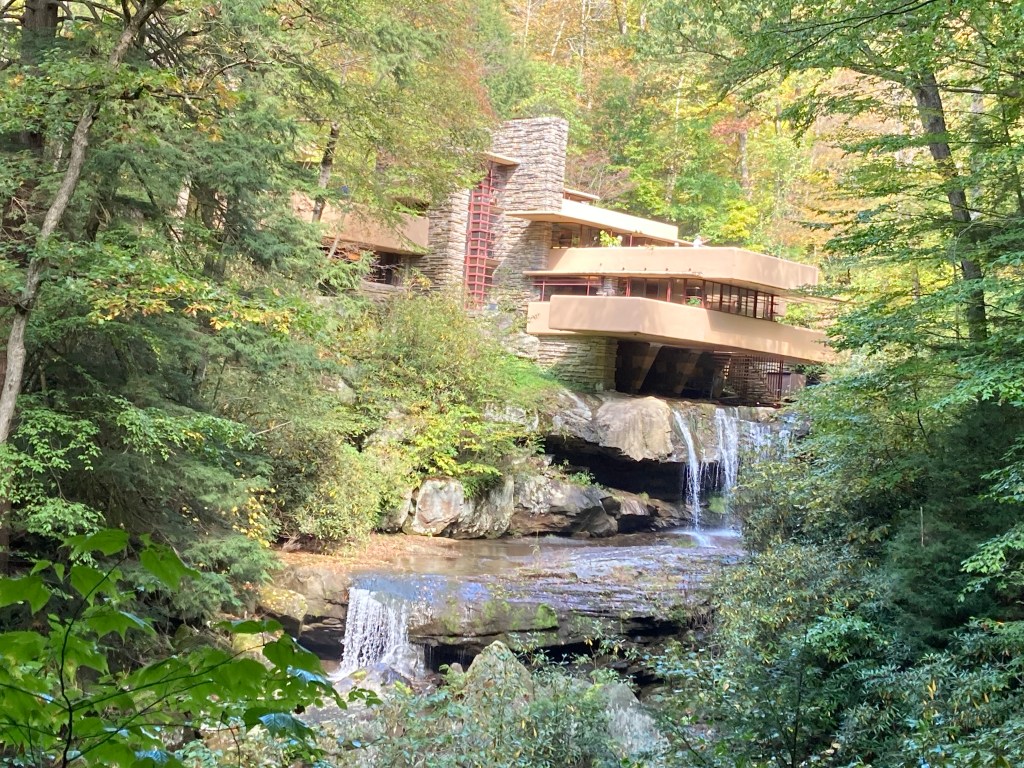
          All of us were at the inn to see Fallingwater, the Frank Lloyd Wright–designed house, famous for its horizontal, cantilevered construction situated over a small waterfall. The house, built in the late 1930s, was commissioned by Liliane and Edgar Kaufmann, the owner of Pittsburgh’s Kaufmann’s Department Store. They used it for weekends until their deaths. Ownership then passed to their son who, in 1963, donated it to the Western Pennsylvania Conservancy, which opened it and its grounds to the public the next year.

          A reservation for a tour is required to see the house, and this is one time when Covid worked to our advantage. Before the pandemic, tours of fourteen were scheduled every six minutes. Now the departures are every twelve minutes with no more than eight in a group. The house did not feel crowded, and the viewing was leisurely, which must not have been true previously.

          The house, of course, is a marvel, but while I liked aspects of it, overall it did not appeal. The main house has low ceilings, which, I guess, are meant to force attention to the outdoors, but it did the opposite for me, giving a cramped feeling. I felt separated from nature in the house, not a part of it. The house has built-in furniture with lines that mimic the exterior but rarely seem inviting. A good house for me has to have good places to read, and this house failed that basic need. However, I did like the beautifully crafted built-in desks, and I would have moved into the separate guest wing–complete with creek-fed plunge pool–in an instant.

Taken by the Spouse
By the Spouse, again

          I have toured other Wright-designed buildings. Fallingwater brought back memories of the Robie House in Chicago, which was built much earlier. The Robie House also has horizontal lines that tend to make me feel squinched (a technical word) and has built-in furniture that echo the lines of the house, furniture that is stylish but not welcoming. The spouse articulated part of what I was feeling when she said, “Wright houses are creepy.” But I am glad that I saw it. It was worth the effort.

          Fallingwater also made me think of Ayn Rand and The Fountainhead. In it she created Howard Roark, an architect, who embodies a version of Rand’s ideal–a man of independence and integrity. The novel’s plot is bad soap opera; the writing is often embarrassing; but I found it to be a page-turner. The book was published only a few years after Fallingwater was built, and Frank Lloyd Wright has been seen as an inspiration for Howard Roark. However, Wright indicates why Rand’s “philosophy” is on the same level of philosophic insights found in a D.C. Comic. (In a New Yorker cartoon, a farmer and son stand in a cornfield with the stalks holding The Fountainhead and Atlas Shrugged. The father says, “If they are reading Ayn Rand, they aren’t mature.”) Wright might have been a creative genius and strong-willed, but as Fallingwater indicates, he was not a truly independent man, and his artistic integrity had to be adaptable.

          An architect needs money to build the envisioned masterpiece, and that requires a patron. Wright needed Edgar Kaufmann, and as our guide made clear, Kaufmann vetoed some of Wright’s ideas and insisted that other details be included. Wright fought for what he wanted, but some of the time he had to yield unless he simply wanted to walk away from the project, which, obviously, he did not do. Apparently, the real-life architect was not an island unto himself.

          An exhibition in the Speyer Gallery, part of Fallingwater’s Visitors’ Center, also brought the “independent” man to mind. It displayed marvelous drawings by Joseph Urban, the Viennese-born architect, illustrator, and scenic designer. In 1928, Edgar Kaufmann asked Urban for Urban’s vision of how to redesign the main floor of Kaufmann’s Department store. The drawings, beautiful and meticulous, showed a dramatic Art Deco space, and I thought of going to Pittsburgh to see what Urban created. But at the end of the exhibit, I learned that Urban did not get the commission; Kaufmann picked someone else for the redesign. A patron may give the “independent” man leeway, but if you need a patron, you are not truly independent.

          Even so, some people read Ayn Rand as if she held a key to the universe. And there are other reasons to feel a sense of despair.

(To be continued.)

Road Trip–Fallingwater Edition (continued)

          Kitty, who owned the bed and breakfast near Fallingwater, came from a military family. This may have led to assumptions about her, but mine were immediately tempered when she showed us a refrigerator for our use. It held two carafes of reverse osmosis water. I have no idea what reverse osmosis water is (the scientist spouse tells me it’s free of impurities), but it sounded rather New-Agey and not something I expected in a military household. A few minutes later she pointed out the smart television in a common area but confessed that she did know how to operate it. David, her husband, would demonstrate it for us when he got home. She continued that she only knew how to get NPR on her radio. NPR. This is a military family?

          In a later conversation, she talked more about her kids. Both had been in the military. After her military stint, her daughter had been working for a federal agency. The Washington offices had been closed for Covid, and she had moved into a cottage in the back of the property. Kitty said that it had been her painting studio. I asked if the accomplished landscapes in the dining room were hers. “Yes,” she replied, “but they aren’t finished.” She looked at me quizzically when I chuckled, and I explained. “We visited an architect’s friend’s home that he had recently expanded. I asked if he was finished with the renovation, and he replied, ‘An architect never says that it is done because then it can be judged.’” Kitty smiled and said, “I like that.”

          Kitty indicated that her daughter had joined the military primarily to get training for a career, but her son, she said with a tiny tinge of disgust, “He wanted to be a warrior.” He, too, had left the military, but he had left because of “TBIs.” I did not immediately know what Kitty meant by that, but later she said he got his second traumatic brain injury stateside. Kitty said that he now had “impulse control” issues and no longer felt that he could effectively lead soldiers. After leaving the Army, he had run a food truck successfully in North Carolina, but recently a developer had taken him under his wing and was training him in the developer’s business. As Kitty mused about the possibility of a good future for her son, I could almost feel her fingers crossing.

          In another conversation, Kitty said that she and her husband had been in construction before they became innkeepers. Primarily they built for the military in southern California, but when a base shut down, they had to find other clients and did a lot of prison construction. Whatever conclusions I might have drawn about a prison contractor were tossed away when she said, “We forget that they are people, too.”

          I can definitely say one thing about Kitty and David: they are great cooks–and not just breakfast cooks. The first night we had a chef’s-choice, prix fixe dinner prepared by them in their open kitchen and dining room. Salad and green beans just picked from their garden, parmesan potatoes, and David’s smoked chicken, followed by a chocolate lava cake. Excellent. I had smoked a chicken a month before, and it had been quite a hit, but David’s was better, and I asked him about it. He had brined it for twenty-four hours, and in good pit master style, told me most, but not all the ingredients for the brine, just as he held back some information about the dry rub applied after the brining. However, he revealed perhaps the most important part of his technique. He carefully monitored the temperature of the smoking chicken, and when it reached 150 to 155 degrees, he took it out of the smoker. Normal advice, given for health reasons, is to cook a chicken until the breast meat is ten degrees warmer. David said that when he removes the chicken, he wraps it in heavy aluminum foil, and the covered bird continues to steam with its own moisture. This made for as juicy and tasty a chicken as I have ever had.

          The meal was so good that we immediately asked if we could eat there again the next night. Alas, Kitty and David require a 48-hour booking. The inn is in a sparsely populated area, and the occasional settlements—they could hardly be described as towns or villages—have few amenities. Any restaurant was hard to find, and many, perhaps because of Covid, were only open on weekends. Another guest said that the previous night they had managed to get sandwiches from a small grocery store miles away and had eaten them in their room. That did not seem appealing. A tavern or two with food were nearby, but Kitty recommended against them, although I am not entirely sure why since we had indicated that bar food was fine with us. Instead, she recommended a steak house that had a wide selection of food. A steak house in a rural area may be fine, but it did not seem especially appealing. After many internet searches, we found a restaurant a few minutes closer than the steak restaurant on the same road. It claimed, of course, wonderful food, but more important, its menu indicated that some of its choices might be slightly out of the ordinary.

          It was a straightforward drive of twenty-five minutes to Moon Shadow near Deep Creek Lake in Maryland. It had a twenty-eight-foot bar at which locals sipped beers, and an outdoor area with a lot of room for kids, not then in attendance, to play. We ate inside a cavernous room with mismatched tables and chairs, only a few of which were occupied. The makeshift stage for a band was empty.

One goal on our road trips is to find a restaurant where, as we put it, someone is cooking, not just reading the microwave directions on institutionally prepared food. And someone at Moon Shadow was, indeed, trying. The spouse had a sous vide pork loin with rosemary (a bit too much rosemary, the spouse reported), not something on the menu of most bars. I had a beefalo meatloaf with a homemade barbecue sauce. Both were quite good. The spouse’s came with tasty baby carrots that were perfectly cooked; mine with garlic peas that were good, but had a bit too much garlic. The over seasoning indicated someone was trying to turn out good, distinctive food, but also revealed inexperience or food insecurity. As an amateur cook, I identified. When ginger or thyme is a highlight in a dish, I tend to add a little more of it than necessary to make it even more outstanding. Perhaps it is only the exceptional chef who has the confidence to season subtly. Nevertheless, when someone tries to present distinctive food–excellent or not–I appreciate the effort as I did at Moon Shadow.

We had come to the restaurant at twilight, but it was dark when we left. We had been using one of those GPS apps that directs you to your destination. I am somewhat nostalgic for the AAA triptiks that always produced a bit of excited anticipation when they arrived before a vacation, but if you don’t know what I am talking about, you’re probably too young to be reading this, and I am not going to explain. The modern technology is much better, and I now sometimes wonder how anyone made it efficiently to an unfamiliar destination in olden (fifteen years ago?) days. However, the Waze lady directing us back to our bed and breakfast decided to toy with us. The trip to the restaurant had been entirely straightforward: turn right at the major intersection and follow that major road for 17 minutes until the restaurant appeared on the right. For our return, however, Ms. Waze put us on unknown local roads—turn right, turn left, go straight, take the left fork—all of which might have made for a scenic drive in daylight, but was somewhat anxiety-producing at night. We were looking for a turn she promised was ahead when the road appeared to run out at some sort of machine shop operating at nine at night. A friendly-looking man came over and apologized for blocking the road. He was amused that the internet device had sent us his way. I then asked a question that I could never before have dreamt of asking: “Do you know where Pig’s Ear Road is?” He told us it was just on the other side of his machinery. We thanked him, swerved around his work, and turned left at the road that had not been visible before. In a few miles, we made it to familiar territory and were soon getting ready for bed. Somehow, it all felt like that impersonal voice had been playing a practical joke.

Road Trip–Fallingwater Edition

We spent our one night in Williamsport at the historic Genetti Hotel, built in 1922 as the Lycoming Hotel when lumbering was still booming in the area. The tallest building downtown (ten stories) with 200 rooms, the Genetti proudly proclaims that it was a speakeasy and bootlegging center during prohibition, has ghosts, and in its heyday hosted many famous people whose pictures line a hall off the lobby. The Lycoming Hotel, as did Williamsport, declined after World War II. The hotel was sold to Gus Genetti and renamed in the late twentieth century. Upgrades have been made to the place, but it retains a certain shabby aura that somehow befits the place. The staff was friendly and helpful, however, and our modest suite, at a modest price, was perfectly fine.

Our difficulty, however, was in finding a place for dinner. We had identified what we thought was a good Williamsport restaurant, but it was not open Sunday night when we were there. We soon found out that most other restaurants in Williamsport were also closed Sunday evenings. That friendly Genetti staff identified the one or two nearby places that were serving, and we were grateful to walk to a quiet pub populated with locals (Williamsport outside of the Little League World Series is not a tourist mecca) that a had a good hamburger and a good pork chop with a good selection of beer. It satisfied.

          The next morning we headed to Fallingwater driving interstates, state highways, and local roads. On the major arteries, signs primarily state the towns and the institutions at the exits. Again, I was struck by the number of educational institutions. Who knew there was an Altoona Bible Institute? On the local roads, however, we spotted a variety of yard signs. Pennsylvania seems to have a plethora of frequently held local elections producing yard signs that usually contain just the candidate’s name and the office sought. (Who runs for tax collector? What are the campaign promises? How do voters make their decisions?) A few yard signs said, “God Bless Our Troops.” (I wondered if this was meant that God should not bless the rest of humanity.) More proclaimed, “We Support the Police.” (And I wondered what that support consisted of and whether my assumption was correct that the signs indicated how the owners felt about Black Lives Matter and the conservative notions of critical race theory.) And what I don’t think I would have seen a decade ago a year after a presidential election and three years before the next one, signs about our national leader. I did not notice any signs supporting Biden, but I did see “Fuck Biden.” (I felt like leaving an ugly graffito that said, “Well, your mother did.”) Some signs seemed left over from last year, saying “Trump 2020.” Others were forward looking with “Trump 2024,” with a more expansive one: “Trump 2024. No More Bullshit.” This I thought was inconsistent unless the owner adopted my position that, in spite of his many falsehoods, Trump is not a bullshitter because a bullshitter has to care about facts and the truth. (See post of December 11 and 14, 2017, “The Bullshitter in Chief: The Bullshitter-in-Chief – AJ’s Dad (ajsdad.blog) and The Bull-Shitter-in-Chief (Concluded) – AJ’s Dad (ajsdad.blog)

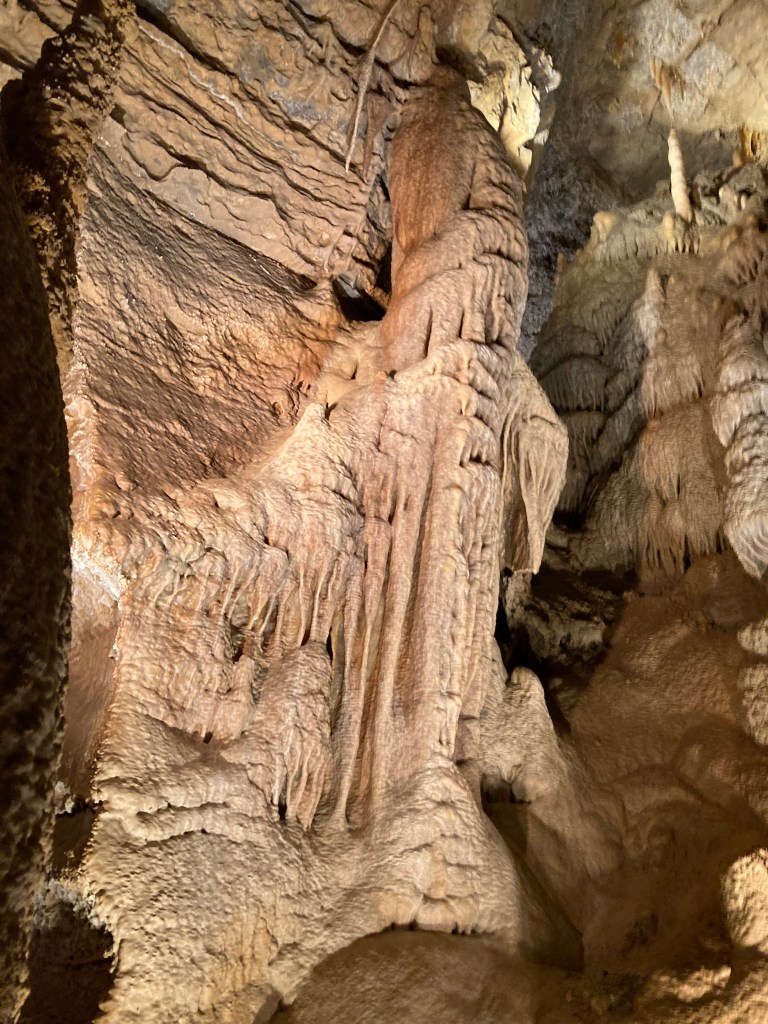
          We did not drive straight through on the longish drive from Williamsport to Addison, Pennsylvania, where our bed and breakfast lodging was located. Instead we detoured to see Lincoln Caverns and Whispering Rock, discovered in 1930 during road construction and owned by the same family since shortly after their discovery. Our descent was led by an affable guide who had spent most of her life in the area. We got an early dose of Halloween because one of the caves was outfitted with “gruesome” dummies and props for spooky tours that were to begin in a few days. This, however, did not interfere with viewing the awesomeness of the caves and its calcite flows including “bacon” formations that looked startingly like the real thing. Limestone underlies much of Pennsylvania, and this apparently results in the creation of many caves. We had seen several signs for other caves open to the public. I asked about the “competitors,” and the guide said that they did not view other caves open to the public as competitors but as colleagues in a joint enterprise. Moreover, the gift shop tried to have brochures from every public cave in the country. I enjoyed our descent, learned much, and now hope to visit other caverns. 

Lincoln Cavern by the Spouse

          After a pleasant outdoor lunch (it was unseasonably warm October weather for all of our trip) in the small town of Huntingdon (home to Juniata College founded by members of the Church of the Brethren in 1876), we drove to our lodgings for the next two nights, Hartzell House, the B and B about ten miles from Fallingwater. The original part of the house was built in 1870 by a returning civil war veteran, but it has been expertly expanded by its present owners and our hosts, Kitty and David.

          Kitty again showed me to be wary of the facile, cliched assumptions that I can make. She led us to our room and opened the closet pointing to robes for our use. We commented on the two military uniforms also hanging there. Kitty said they had belonged to her father who had been in the Army Air Corps in World War II, and that is why this was called the Patriot Suite. (The room also had a dozen books on military history.) She went on to say that both her son and daughter had been in the military, and, reflexively, because of all these connections to the armed services, I drew conclusions about Kitty and her values and politics. But these became almost immediately upended.


Road Trip–Fallingwater Edition

          Compared to those of some of my friends, my travels have been limited. I have not been to Tanzania, South Africa, or Ethiopia. I have not gone to Kazakhstan or Mongolia. I have been to neither Argentina, Brazil, nor Chile. I have not been to Japan, China, or Singapore, or New Zealand or Australia, or even Scotland or Ireland, much less the Faroe or Shetland Islands. But, in pre-Covid times when the spouse and I talked about trips to some of these places, we also realized that we had not traveled to many potentially interesting parts of the United States, some not far from us. We started planning driving trips to places we had not been before with stops along the way to see some local attractions.

          And so, recently we drove from our northeast Pennsylvania house with the goal of visiting Fallingwater, the house designed by Frank Lloyd Wright over a small waterfall. The trip had been planned months before with hopes of seeing some fall foliage along the way. While occasionally we had stretches of a mile or two with yellows and reds, the deciduous trees remained largely green, perhaps, we speculated, because the autumn had been warm. We realized, though, that we did not know why leaves turned colors—was it colder weather or shortening days or both? Although we have many, many years of education between us, we had to concede ignorance of these matters.

          The first leg of our trip was a two-hour drive from our Pocono Mountains home to Williamsport, Pennsylvania, a town of about 30,000, perhaps best known today as the home of the Little League World Series and a museum for the same. That held little interest for me, but it did not matter because the museum was not open, presumably because of Covid.

          We arrived for lunch at the Sawhorse Café, a tiny, crowded restaurant on the edge of a college campus with good food that came after an inordinately long wait. I was struck yet again by the fact that this country has a vast number of colleges and universities many of which, even though I was an academic for decades, I have never heard of or know little about, including Lycoming College which was a few blocks from the café. To my surprise I found that Lycoming, a private coeducational institution of about 1,200 undergraduates and affiliated with the United Methodist Church, was one of the oldest colleges in the country with roots going back to the early nineteenth century. I had at least heard of Lycoming before going to Williamsport, but I had no previous knowledge of the public Pennsylvania College of Technology, with 5,400 undergrads, which is also located in Williamsport.

          After lunch we went to the Thomas T. Taber Museum of the Lycoming County Historical Society. (Mr. Taber is a local historian and philanthropist.) The spouse and I have now learned to seek out small-town museums. Many of them are surprisingly good, exposing us to history and artists we do not know. The Taber Museum is an outstanding example with geology, Native American, lumbering, weaving, and blacksmithing exhibits. The spouse was most impressed with a demonstration of a complicated, ingenious, nineteenth-century rickrack weaving machine. (She had to educate me about rickrack.) We were both amazed that someone had invented such a thing that was simultaneously useful and beautiful.

          I was drawn to the extensive displays about the development of Williamsport’s lumbering industry, the source of the region’s late nineteenth century wealth. It was clear that the work was hard and dangerous, not just the felling of the timber but also the floating of a huge number of logs down a branch of the Susquehanna River where Williamsport is located. The industry was essential in the development of the town, but, of course, a ready supply of lumber fueled the development of many parts of America.

          In the blacksmith section, I learned that oxen have small hooves split into two sections. Each foot requires two small shoes, but oxen cannot support their massive weight on only three legs. The smithy could not shoe an ox the way I had seen horses shoed many times in old western movies where the leather-aproned blacksmith picks up a leg and nails on a horseshoe. Instead, a sling was invented to bear part the ox’s weight so that a leg could be raised and the two ox shoes could be hammered onto each foot.

          Other exhibits documented Williamsport’s famous Repasz Brass Band, which was founded in 1831 and claims to be the country’s longest continuously operated band. However, the Taber Museum is especially known for its model trains, a collection of one person, Larue Shempp. It contains over 2,000 pieces and 347 complete train sets, some of which run in large, interactive displays. Awesome.

          The visit-worthy Taber Museum is housed in a modern building, but it is situated on Millionaires’ Row, a national historic district. The street is lined with fantastic, extravagant homes built in the Victorian era. The town proclaims, “Once the Lumber Capital of the World, Williamsport had more millionaires per person than any other city in the USA.” I remembered a similar boast when we were in Merida, Yucatan, which proclaims that, at the turn of the 20th century, Merida had more millionaires than any other city in the world. I wonder how many other towns or cities make similar claims.

Most of the homes on Williamsport’s Millionaires’ Row have now been broken up into apartments and offices, but the Rowley House, finished in 1888, is open to the public—unfortunately not on the day we were there. The helpful, friendly staff member at the Taber Museum made a call to a gregarious, eighty-nine-year-old volunteer at the Rowley House. He agreed to meet us there and show us around, but then he remembered that an alarm was set. He had not written down the code and could not recall it, and, thus, we could not visit the nineteenth century house.

Snippets

A reason I know that I am an optimist: When I look in the mirror, I only see the hairs that remain, not the areas they have vacated.

“A pessimist is a man who has been compelled to live with an optimist.” Elbert G. Hubbard.

Below “Exit 18,” the roadside sign said, “Attractions.” Sadly, nothing was listed.

Baseball playoffs are taking place and again I wonder how it originated that baseball players throw the ball around the infield after the first and second outs with no runner on base? Why is the first baseman often excluded from the ritual? Why does the third baseman always throw the baseball to the pitcher?

Remember “crack babies”? Thirty years ago, the press was filled with stories about children being born to mothers addicted to crack cocaine, often somewhat politely called “crack mothers,” but often labeled “crack whores.” The kids were supposedly permanently damaged and would harm society for generations to come. So, they should be harming us inordinately right now. Why don’t we hear about that? Is it because those scare stories weren’t true? And a quick experiment: Imagine a “crack baby” or a “crack mother.” Did any of you see a white woman or white child?

“Racism is pervasive. The pretense that it belongs solely to poor people who talk slow lets the rest of us off the hook.” Rebecca Solnit, The Encyclopedia of Trouble and Spaciousness.

I believe that I am planning for the future when I buy two cases of beer instead of one.

Sign on the back of a “waste management” truck: “Satisfaction guaranteed, or your garbage refunded.”

I learned that Norman Rockwell, the famous illustrator of American home life, and his first wife practiced free love. Perhaps you already knew that. If not, would you now look at his illustrations differently?

I have a book in my hand. It seems permanent, not so much the physical object, but the content. And, of course, to some extent that is true. I have read books that were published centuries ago, but most books, even well-received ones, are quickly forgotten. Whenever I get a book out of the library, I look at the return dates stamped in the book. Most of the older ones have not been checked out in years. A physical book may still be on somebody’s shelves, but does it really exist if it is not read?

Why is it when you sleep fitfully all night that you are sound asleep when it is time to get up?

First Sentences

“In the corner of the small living room of the small country house at the end of the dirt road beneath the blue Carolina sky, the dark-skinned five-year old boy sat with his knees pulled to his chest and his small, dark arms wrapped around his legs and it took all that he had to contain the laughter inside the thrumming cage of his chest.” Jason Mott, Hell of a Book.

“We all want to know how it was in the beginning.”Nathaniel Philbrick, In the Heart of the Sea.

“Well, the sun was shining.” Rumaan Alam, Leave the World Behind.

“The silence was excruciating, the minutes ticking by thick and heavy, time itself gorging on the tension in the humid air.” Ben Mezrich, Once Upon a Time in Russia: The Rise of the Oligarchs—A True Story of Ambition, Wealth, Betrayal, and Murder.

“Mayya, forever immersed in her Singer sewing machine, seemed lost to the outside world.” Jokha Alharthi, Celestial Bodies.

“English rule of Ireland was achieved by force, maintained by force.” Wayne G. Broehl, Jr., The Molly Maguires.

“I was born to be a wanderer.” Maggie Shipstead, Great Circle.

“On the third day of October 1901, Abram S. Hewitt was a happy man.” Clifton Hood, 722 Miles: The Building of the Subways and How They Transformed New York.

“Still hours of dark to go when I left home that morning.” Emma Donoghue, The Pull of the Stars.

“Senior Lieutenant Alexander Logachev loved radiation the way other men loved their wives.” Adam Higginbothan, Midnight in Chernobyl: The Untold Story of the World’s Greatest Nuclear Disaster.

“Simon the Fiddler had managed to evade the Confederate conscription men because he looked much younger than he was and he did everything he could to further that impression.” Paulette Jiles, Simon the Fiddler.

“Texas, perhaps more than any other state in the Union, lives in the public imagination as a place of extremes.” Annette Gordon-Reed, On Juneteenth.

“On Saint Patrick’s Day, Daniel Coleman, an agent in the New York office of the Federal Bureau of Investigation handling foreign intelligence cases, drove down to Tyson’s Corner, Virginia, to report for a new posting.” Lawrence Wright, The Looming Tower: Al-Qaeda and the Road to 9/11.

“The day was flat.” Douglas Stuart, Shuggie Bain.

“On October 5, 1936, thousands of people packed the unpaved roads of Van Meter, Iowa.” Luke Epplin, Our Team: The Epic Story of Four Men and the World Series that Changed Baseball.

Words, Words, and More Words (concluded)

William and Mary Morris in their book the Harper Dictionary of Contemporary Usage promote standards for the English language that were unknown to me and are likely to fade from my memory. For example, the “fine distinction between completely and wholly should be observed in formal writing.”  While they sought to preserve many seemingly arcane distinctions, the Morrises surprisingly concluded that some standards had passed away. (“Pass away/pass on. Euphemisms for ‘to die.’ Both should be avoided.”) Most surprising: “The subjunctive mood of verbs is used to express hypothesis, supposition, contingency. You don’t hear or read the subjunctive much any more. Nowadays the way language is used by educated, literate speakers and writers is the final criterion, and, by this standard, the subjunctive is today just about dead.”

The subjunctive continues to bedevil me. I have read several language “experts” on the topic, and they seem to be inconsistent upon when it should be used. Perhaps it should be abandoned simply because of the trouble it presents. (Mark Twain said: “Damn the subjunctive. It brings all our writers to shame.”) Perhaps I should totally abandon its use, but in spite of what William and Mary wrote, I know that many people, including “educated, literate speakers and writers” continue to struggle to use it correctly. Perhaps I should accept what they say and give up the burden of trying to get it right.

All this highlights the difficulty for those trying to identify what is appropriate English usage. The language is not static; it changes, and no one can know the precise point when some substandard usage becomes acceptable. That is also true for the creation or new use of words. William and Mary Morris refer to vogue words that crop up suddenly, get attention, but “soon become debased by overuse and lose their initial sparkle and freshness.” They gave a list from thirty or more years ago: “input, output, hangup, freak out, flap, camp, kitsch, watershed, bench mark, overview, empathy, infrastructure, phase (in and out), ongoing, seminal, in depth, feedback, escalate, relevant, generation gap, clout, biodegradable, interface, parameter, ingroup, outgroup, peer group, synergy and synergistic, and longuette.” Presumably the authors thought these terms would largely have disappeared by now, but many of them are still in frequent use. However, I would like to banish some of them. I just turned off a TV show about cars during which the voiceover told me about driver inputs. I would have been embarrassed to have said that, but there it was. But some of those vogue words–even those that are cringeworthy–have not disappeared but have settled into secure and useful places in the language. It is hard to predict the development of English.

If the language is constantly changing, why try to promulgate standards of what some maintain is correct usage? A century ago Ambrose Bierce would demean such a standard bearer as a “lexicographer”: “A pestilent fellow who, under the pretense of recording some particular stage in the development of a language, does what he can to arrest its growth, stiffen its flexibility and mechanize its methods.”

In an epilogue, panelists for Contemporary Usage commented on this tension between correct usage and ongoing language development. Frances Fritchman said, “We are not just quaint antiquarians opposing progress. What we are really fighting for is clarity, accuracy, exactitude—qualities never more needed than now!” Of course, every age probably says that clarity and accuracy are essential, but it is correct that standards can help assure proper communication. (Some would, however, vehemently object to that exclamation point.)

The panelist Vermont Royster also makes that point: “What I deplore is the debasement of the language, whether from violation of the simple and logical rules of grammar or from using good, useful words wrongly. . . . The consequence is a breakdown in communication. Not only are subtleties and shades of meaning lost, but in some cases there is actual misunderstanding between writer and reader, the writer intending one meaning, the reader receiving another. This occurs no matter whether it is the writer or the reader who is using the language wrongly.” However, in spite of what Royster says, the rules of grammar are often not simple and logical. For example, even though recognizing its illogicality, William and Mary Morris maintain that the “preferred usage is ‘two times two is four,’ not ‘two times two are four.’” But why does it matter for accurate communication whether is or are is used?

Similarly, should there be a concern if a subtlety or shade of meaning is lost if the communication is still clear? The panelist Earl Ubell wrote: “When someone says ‘I am nauseous’ rather than the correct ‘I am nauseated,’ I have to learn to hold my tongue because if I make the correction, no matter how gently, my respondent responds with a grimace that say ‘Pedant! Elitist! Nit-Picker!’ and worse.” (Wasn’t it condescending to write to William and Mary Morris and the other panelists that “nauseated” was correct?) Who doesn’t understand me if I say “I am nauseous” or “A nauseating smell came from the rendering plant”? If the communication is clear, when is it pedantry to say the “wrong” word is used? Since I learned at about the age of sixty-five the difference between the two words, I have tried to use them correctly, but I believe that I was understood perfectly well before then. (The Morrises, unwittingly anticipating and differing with Royster, say about the increasing misuse of “nauseous,” “it seems reasonable to infer that we may be here considering an instance of gradually changing usage.”)

Correct usage, however, can also help the struggle against pomposity and euphemisms. Elizabeth Hardwick, another panelist, wrote, “I feel a great many of the barbarisms are an expression of distrust of simple language, a fear that the simple words are not refined enough. . . . Bureaucratic, Latinate words are preferred to old root words of common speech. All of this depresses me.” Clear, simple language is worth promoting, but I also like Hardwick’s openness to new formulations. She also said, “On the other hand I love new coinages from ‘street language’ when they are imaginative and fresh. I like ‘split’ for going away quickly. . . .”

Her comment made me think of when I first heard dissed, as in, “He dissed me.” When I understood that coinage, it conveyed in a succinct manner something meaner than “He insulted me” or “He ignored me.” It had value. Promoting English language standards should not stand opposed to all changes in speech and writing.

 As I write this, I wonder why I read style and usage books, and I realize that mostly I hope to make my speech and writing clearer and more precise. But I also realize that there is something more at work. I like words. They are fascinating and magical. I simply like learning about them. The use of some words can make me cringe; the use of some words is befuddling. However, the use of some can please and delight. I read the guidebooks in hopes of being better able to use words well. I agree with Evelyn Waugh who said, “Words should be an intense pleasure just as leather should be to a shoemaker.” I have never made shoes, but I like both words and leather. So, I read on.

Words, Words, and More Words

I have been rereading  the Harper Dictionary of Contemporary Usage (Second Edition) by William and Mary Morris. I am not sure when I first read it, but it was probably a few years after the book was published in 1985. I recognized the authors, a married couple both born in 1913 (she died in 1986, he in 1994) from their syndicated column “Word, Wit, and Wisdom.” I read it regularly as a kid in the Milwaukee Journal. I remember only one specific lesson from that column: They informed me that slow is both properly used as an adjective and an adverb. Therefore, “I drove slow” is as correct as is “I drove slowly,” something that my editor, the spouse, still refuses to accept.

Contemporary Usage gives advice that I wish I would follow, such as “die should be followed by the preposition ‘of’ rather than ‘from.’” Or: “Care should be taken not to confuse bemused with amused. A person bemused is deep in thought, sometimes to the point of stupefaction. He is most definitely not laughing.” [Editor’s note from the spouse: I knew that.] I’m pretty sure that I will not remember all that I should from the book.

The authors’ writing is clear, informative, and amusing. And frequently adamant: “The nonstandard thusly must have been coined by someone who thought that all adverbs have to end in ‘-ly’ or thought thusly was a little more ‘elegant’ than just ‘thus.’ In any event it is an abomination. ‘Thus’ is stuffy enough for all normal purposes. See also FIRSTLY/THUSLY.

The authors, however, did not just rely on their own knowledge. They also submitted questions of disputed usage to a panel of 165 authors and editors and reported the results citing specific comments from some of them. For example, the authors wrote to the panel:

“In recent years the verb ‘to burgeon’ has been, in opinion of purists, widely misused. Its primary sense is simply ‘to bud,’ yet it has been widely used as synonymous with ‘to mushroom.’ Would you accept ‘the rapidly burgeoning city of Dallas’?”

In writing, 39% said yes, and for speech , 46%. Michael J. Arlen commented: “It’s bad enough that people use words such as burgeon because they’re sexier than ‘grow.’ At least let them use an accurate word.” Stewart Beach: “I’m afraid the incorrect meaning has gained so much acceptance it will be hard to stop.” Walter Cronkite: “I would not use it now that the definition has been called to my attention.” A.B.C. Whipple: “It’s probably better than the ‘mushrooming city of Dallas.’ In fact, it’s probably better than Dallas.”

Besides giving sound advice on words and pronunciations, Contemporary Usage also documents the fast-changing nature of what is considered to be good English. The book’s first edition was published only ten years before the second edition, and most of the earlier content appears in the later version. However, sometimes the authors recognized that the language was so rapidly changing that some questions of the first panel should be asked again of the second. For example, 42% of the first panel said hopefully in the sense of “we hope” was acceptable in conversational speech but only 24% accepted it in writing. A decade later, the panel was less tolerant, with 30% accepting it in speech and only 17% in writing.

Sometimes the changing nature of the language can be seen from a single query as new words become more widely accepted. For example: “Would you regard underclass as still another euphemism for ‘poor,’ like ‘underprivileged’ and ‘disadvantaged’? Yes: 49%. No: 51%.” Is the term underclass “a valuable addition to the lexicon of words dealing with society’s problems? Yes: 41%.”

All language stylebooks want to save distinctions between words: “A student does not pour over his books; he pores over them.” A value to me in such books is to learn distinctions that I did not know or only vaguely know, such as “practicable/practical” or “glimpse/glance.” Sometimes there is a distinction or standard that I know and I try to keep, but reading about it makes me wonder if I should care. For example, 90% of the usage panel would maintain a distinction between precipitous and precipitate, a distinction I learned late in life and long after such a distinction was necessary to my existence.

Sometimes, however, the authors tried to maintain standards that were better buried. For example, the Morrises maintained that kudos is singular and “there is no such thing as a ‘kudo.’” They go on to say that while some dictionaries list kudos as both singular and plural, “if it is more than one high honor you are talking about, make it kudoses.” William and Mary have lost out. At least one online dictionary lists kudo as the singular and kudos as a plural. I, for one, have never seen or heard kudoses used, and I am not about to start using it now.

 On a few occasions in the book, the authors seemed to promote a word’s usage, but failed. For example: “With the return of beards to fashion and with barbers becoming ‘hair stylists,’ the term pogonotomy may come back into use. It is made up of two Greek word, ‘pogon,’ meaning ‘beard’ and ‘-tomos,’ meaning ‘cutting.’” And: “Turophile is a word which has recently made it into the pages of unabridged dictionaries and one which Clifton Fadiman is credited with coining. It means ‘a connoisseur or fancier of cheese,’ and comes quite logically from two Greek words: ‘tyros’ for ‘cheese’ and ‘philos’ for ‘loving’.”  Both these words are in modern dictionaries but are not much used, or thankfully (or perhaps, “I am thankful”), not much used in my presence. I might find the use of oenophile pretentious, but progonotomy and turophile are just plain silly.

(concluded October 13)

Toy Retreat

(Guest Post from the the NBP–the Non-Binary Progeny)

I didn’t realize it as a child, but now I see that I was pretty angry about a lot of things in my young life. I didn’t look like my parents (other kids looked like their parents!), and besides that, I was trapped in a body that I really didn’t like—a body I came to hate, but more on that later. When confusion and anger overwhelmed me, I would go into a zombie-like meditative state and lose myself in my toys.

Several toys consumed me. Whether it was G.I. Joes or Transformers, I became transfixed. I also had an assortment of Lincoln Logs, Matchbox cars, plastic dinosaurs, and other animals for whom I created worlds for us to get lost in. Sometimes those worlds only consisted of marching the dinosaurs around and having them meet the cars and the tigers, but it was enough for me to forget about myself for a time. I loved my “boy” toys.

I hated dolls. I once had a doll my mom named Chamomile (I wouldn’t even deign to name her), given to me by a family friend. Chamomile was a Japanese doll with a porcelain face, straight jet-black hair, and a red kimono. Didn’t this couple—Japanese scholars both—know that Koreans and Japanese aren’t the same thing? Well, I didn’t at the time, so I thought I was supposed to look like this doll; I couldn’t have been more insulted! Okay, well, they couldn’t have known that this Asian (I barely knew I was Korean, only some brand of Asian) toddler despised dolls of any ethnic background. No dolls. Period. This doll was not allowed in my room. I wanted to put her six feet under because I wholly rejected any resemblance to her and flat out thought she was creepy with her piercing eyes and her perfectly puckered lips. [Shivers!] My mother consigned her to a closet, where I wouldn’t be able to see her, nor she me. Obviously, dolls were forever banned from my toy repertoire.

One Christmas—I was about five—my grandpa made me a dollhouse. Built it himself—an old man building a dollhouse. Awww, sweet. I destroyed it. Like a little ungrateful brute, I kicked it in because it screamed to me, “YOU ARE A GIRL.” I feel guilty about demolishing it, and I know my parents were upset that I had done so since it was such a nice thing my grandpa did (and, apparently, he wasn’t always the cuddliest fellow in the world), but I couldn’t stand it. In hindsight, I could’ve at least tried to use the dollhouse as a G.I. Joe headquarters.

The only other “girly” toys I remember owning were My Little Ponies. They were stupid and pink and purple and “girl” colored but ultimately accepted into the mix because they were useful as beasts of burden. All my action figures were allowed to use them as mules and horses for carry and cargo. Mwahaha.

I was a huge fan of Legos and spent hours building Lego cities, both modern and medieval. These were extravagant constructions with multiple dwellings, roads, vehicles, people. Sometimes these architectural masterpieces remained assembled for quite some time…months at least. After a while I would notice that the yellow, blue, and red blocks started looking more and more like the gray ones. Excitedly, I would go majorly OCD. Paintbrushes of all sizes would be assembled and used to dust every nook and cranny. Fan brushes were especially effective, in case you were wondering! Dusting became another therapeutic zombie activity. It required few brainwaves and at the end, when I snapped out of my dusty reverie, I would feel a sense of accomplishment. All my knights, castles, pilots, drivers, and civilians now lived in an allergen-free world! It took hours—blissful, non-thinking hours.

Talking about paintbrushes, art was another outlet for me. Not only was it easy to get lost in, but it was an activity relatively free of gender overtones. My zombie self was an abstract artist veering towards Modernism with lines, colors, patterns, and shapes plunked all over a page; we (my Zombie and I) used crayons, markers, watercolors, pastels, colored pencils, acrylics. These artistic adventures could last for hours in which I would achieve my “zombie-zone”—anger synapses asleep. Pages upon pages would pile up on my art table. Once I had a formidable stack, I would gather together as many pages as the stapler allowed, and add a cover with a clever title (e.g., “Lines and Shapes”) and my name. It amazed and impressed my parents when the zombie state came on because I’d be intent for such long periods of time that they thought it indicated a profound ability to focus on a task. They didn’t know—and neither did I—that it was really a way to unfocus and go to another, less complicated place.

Later on these drawings became distinctly warlike. Knights, axes, swords, battleships, and airplanes shooting fire, bullets, missiles, bombs, ahem all manner of projectiles, figured prominently. The knights or the soldiers were always either armed or had rippling arms themselves. These drawings required total concentration, and the time spent drawing them—images of death-inducing weapons though they might be—had a calming effect on me. Whatever the zombie and I did, it was done subconsciously to calm an inner rage, and it sort of worked.

Warrior wannabe (or disturbed child, ha. Ha. Ha?) though I may have been, I loved stuffed animals. They were cute and soft and uncomplicated (boys had them, too!). Stuffed animals were also good friends because if you felt the need to hit things or throw things against a wall, they could take it. They didn’t get upset or scream or cry. They just pleasantly smiled (hopefully without crying on the inside).

I always had one favorite, and he was never in harm’s way. The first favorite was a super soft leopard with wonderful spots named Larry. Larry had plastic whiskers great for chewing on. Then came Steven who was a tan mini-Gund bear. He loved to have his tummy rubbed and rubbed and rubbed.

Needless to say, all my animals were male, except for one pink Gund bear named Susan. Me, the blossoming little sexist, made her the bitch. Talking about sexism: Loving stuffed animals—being suckered in by cute things—seemed like a disturbingly girly thing to do. Dusting Legos also made me feel girly because neatness and cleanliness were attributes associated with girls. I tried not to think about this too much, because even if they were girly, they were necessities.

Then came William, William T. Bear (his middle name was “The” not “Teddy”). When I received William, a chocolate brown grizzly bear and held him for the first time, he felt so new and soft and was the ultimate in cuteness and comfort—100 percent ergonomic…for hugging. Oh, he even smelled good. I knew we’d have a special bond. He was a present from my father, which made him already special—even magical. I gave him a voice, and in turn, he gave me one. I manipulated and animated him like a puppet (but he’s not a puppet, damn it, he’s real!). I brought him to life by moving him: body, limbs, even ears. I gave him emotions and ascribed body movements to each feeling. I was never without William at home, and I dreaded leaving him behind when I went to school. He was a shield and a security blanket, and a rather excellent companion. William was also a useful communication conduit to my parents. My parents, not bears of small brain themselves, caught on quickly. They would ask me if William were tired, or if William were sad, and William, less guarded than I, would answer truthfully and unassumingly. I, who rarely spoke more than a word or two even at home, became quite vocal and lively when William was around. He was a bubbly bear and made even me laugh. William was who I wanted to be. He was funny and simple and innocent and silly and male. He was not evil, though naturally being a bear, he grrrred a lot. He made my anger disappear. He was the light side to my dark. (Shhh. Don’t tell, but he’s watching Top Chef next to me as I write this.)