Trump versus Madoff

Near the end of his book Madoff: The Final Word, written shortly before our president won his second term, Richard Behar asks comparative questions about the con man Bernard Madoff and Donald Trump:

“Should there be an attempt at an analysis and comparison of Madoff and Trump—arguably the greatest fabulists of (for Madoff) the contemporary business world and (for Trump) the political world? Do they know when they lie? Do the 2020 presidential election deniers have anything in common with investors who blindly followed Madoff? And can denial be contagious and transmissible across huge segments of society?”

There may be intriguing comparisons between the two, but the fabulists were of different sorts. To effectuate his Ponzi scheme, Madoff faked stock trades. Of course, Madoff knew that he was not making the trades. He lied about them. Lies require an understanding and concern for the truth. Lying calls for a degree of craftsmanship that weaves in the truth in order to get the lie accepted. Harry G. Frankfort in his marvelous little book, On Bullshit, says: “In order to invent a lie at all, [the liar] must think he knows what is true. And in order to invent an effective lie, he must design his falsehood under the guidance of that truth.” Thus, Madoff made up the trades, but not the prices for the supposed transactions. He backdated the “trades” and then could pluck out real stock prices to make it seem that his funds had made profits. If someone had checked his trading ledgers, they would see entries that Madoff bought a security for x dollars on a certain date, and indeed the stock did sell for that amount then. The business record would also show that on another date, Madoff sold the shares for more than x dollars, once again a valid price for that date. The prices were real; the trades were a lie, but in hopes of being believed, he lied under the guidance of truth.

Frankfort makes a distinction between the liar, who has a concern for the truth, and the bullshitter who does not. A bullshitter’s “statement is grounded neither in a belief that it is true nor, as a lie must be, in a belief that it is not true. It is just this lack of connection to a concern with truth—this indifference to how things really are—that I regard as of the essence of bullshit.” And since our president does not seem to craft lies as much as utter falsehoods with an indifference to the truth, he is, by this definition, not a liar.

The bullshitter has more freedom than the liar. The bullshit artist “does not limit himself to inserting a certain falsehood at a certain point, and thus he is not constrained by the truths surrounding that point or intersecting it. He is prepared, as far as required, to fake the context as well.” Frankfort continues, “He does not care whether the things he says describe reality correctly. He just picks them out, or makes them up, to suit his purpose.” The bullshitter is not rejecting the authority of truth, as the liar does. Instead, “he pays no attention to it at all.”

Many wonder how Trump can tell so many falsehoods, or how he can repeat falsehoods that have been repeatedly debunked, or how he can assert things that on their face are blatantly false. They haven’t recognized that while a liar and truth-teller are on opposite sides of the same contest, the bullshitter is not even in this game. Trump does not grapple with the authority of truth, as the liar does. Instead, as with any bullshitter, “he pays no attention to it at all.”

If Trump lied, he would not be as dangerous. Frankfort writes, “By virtue of [not paying attention to the truth], bullshit is the greater enemy of the truth than lies are. . . . Through excessive indulgence in [bullshit], which involves making assertions without paying attention to anything except what it suits one to say, a person’s normal habit of attending to the ways things are may become attenuated or lost.”

There may be many causes for Trump’s bullshit—his narcissistic ego is a prime reason, but there is at least another one. “Bullshit is unavoidable whenever circumstances require someone to talk without knowing what he is talking about.” Those of us concerned with the truth should give up the notion that Trump will learn what is true and what is not and that the falsehoods will decrease over time. As long as Trump continues to talk about things he knows little to nothing about, the bullshit will continue.
Road Trip–Fallingwater Edition

We spent our one night in Williamsport at the historic Genetti Hotel, built in 1922 as the Lycoming Hotel when lumbering was still booming in the area. The tallest building downtown (ten stories) with 200 rooms, the Genetti proudly proclaims that it was a speakeasy and bootlegging center during prohibition, has ghosts, and in its heyday hosted many famous people whose pictures line a hall off the lobby. The Lycoming Hotel, as did Williamsport, declined after World War II. The hotel was sold to Gus Genetti and renamed in the late twentieth century. Upgrades have been made to the place, but it retains a certain shabby aura that somehow befits the place. The staff was friendly and helpful, however, and our modest suite, at a modest price, was perfectly fine.

Our difficulty, however, was in finding a place for dinner. We had identified what we thought was a good Williamsport restaurant, but it was not open Sunday night when we were there. We soon found out that most other restaurants in Williamsport were also closed Sunday evenings. That friendly Genetti staff identified the one or two nearby places that were serving, and we were grateful to walk to a quiet pub populated with locals (Williamsport outside of the Little League World Series is not a tourist mecca) that a had a good hamburger and a good pork chop with a good selection of beer. It satisfied.

          The next morning we headed to Fallingwater driving interstates, state highways, and local roads. On the major arteries, signs primarily state the towns and the institutions at the exits. Again, I was struck by the number of educational institutions. Who knew there was an Altoona Bible Institute? On the local roads, however, we spotted a variety of yard signs. Pennsylvania seems to have a plethora of frequently held local elections producing yard signs that usually contain just the candidate’s name and the office sought. (Who runs for tax collector? What are the campaign promises? How do voters make their decisions?) A few yard signs said, “God Bless Our Troops.” (I wondered if this was meant that God should not bless the rest of humanity.) More proclaimed, “We Support the Police.” (And I wondered what that support consisted of and whether my assumption was correct that the signs indicated how the owners felt about Black Lives Matter and the conservative notions of critical race theory.) And what I don’t think I would have seen a decade ago a year after a presidential election and three years before the next one, signs about our national leader. I did not notice any signs supporting Biden, but I did see “Fuck Biden.” (I felt like leaving an ugly graffito that said, “Well, your mother did.”) Some signs seemed left over from last year, saying “Trump 2020.” Others were forward looking with “Trump 2024,” with a more expansive one: “Trump 2024. No More Bullshit.” This I thought was inconsistent unless the owner adopted my position that, in spite of his many falsehoods, Trump is not a bullshitter because a bullshitter has to care about facts and the truth. (See post of December 11 and 14, 2017, “The Bullshitter in Chief: The Bullshitter-in-Chief – AJ’s Dad (ajsdad.blog) and The Bull-Shitter-in-Chief (Concluded) – AJ’s Dad (ajsdad.blog)

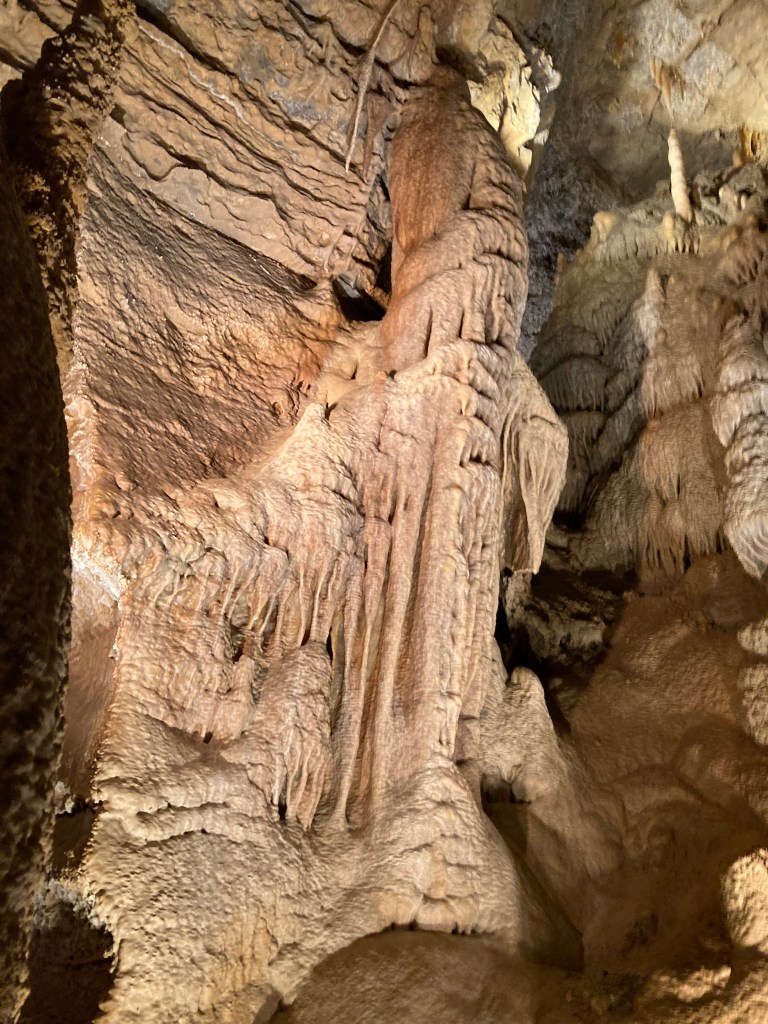
          We did not drive straight through on the longish drive from Williamsport to Addison, Pennsylvania, where our bed and breakfast lodging was located. Instead we detoured to see Lincoln Caverns and Whispering Rock, discovered in 1930 during road construction and owned by the same family since shortly after their discovery. Our descent was led by an affable guide who had spent most of her life in the area. We got an early dose of Halloween because one of the caves was outfitted with “gruesome” dummies and props for spooky tours that were to begin in a few days. This, however, did not interfere with viewing the awesomeness of the caves and its calcite flows including “bacon” formations that looked startingly like the real thing. Limestone underlies much of Pennsylvania, and this apparently results in the creation of many caves. We had seen several signs for other caves open to the public. I asked about the “competitors,” and the guide said that they did not view other caves open to the public as competitors but as colleagues in a joint enterprise. Moreover, the gift shop tried to have brochures from every public cave in the country. I enjoyed our descent, learned much, and now hope to visit other caverns. 

Lincoln Cavern by the Spouse

          After a pleasant outdoor lunch (it was unseasonably warm October weather for all of our trip) in the small town of Huntingdon (home to Juniata College founded by members of the Church of the Brethren in 1876), we drove to our lodgings for the next two nights, Hartzell House, the B and B about ten miles from Fallingwater. The original part of the house was built in 1870 by a returning civil war veteran, but it has been expertly expanded by its present owners and our hosts, Kitty and David.

          Kitty again showed me to be wary of the facile, cliched assumptions that I can make. She led us to our room and opened the closet pointing to robes for our use. We commented on the two military uniforms also hanging there. Kitty said they had belonged to her father who had been in the Army Air Corps in World War II, and that is why this was called the Patriot Suite. (The room also had a dozen books on military history.) She went on to say that both her son and daughter had been in the military, and, reflexively, because of all these connections to the armed services, I drew conclusions about Kitty and her values and politics. But these became almost immediately upended.


Postmodernist Trumpism (continued)

          At its inception, literary postmodernism had little effect on the broader world, but it is not surprising that postmodernism spread. The deification of the subjective is comforting and appeals to basic human impulses. It fits into an “I’m ok/you’re ok” world. It tells me that what I believe is valid. It comforts because it relieves me of the often difficult job of finding facts, of ascertaining the truth, or grappling with determining what is good science, history, or journalism. In a world where knowledge is simply socially constructed, I do not have to abide by the standards of good historical, scientific, sociological, or anthropological inquiry. I don’t have to grapple with the strengths and weaknesses of sets of data. I can just stop with my inquiry once something feels right for me. The postmodernist death of objectivity as Stanley Fish says, “relieves me of the obligation to be right.” (Quoted in Michiko Kakutani’s book The Death of Truth.)

          Postmodernism is also comforting because it means I don’t have to grapple with information or views I don’t like and the conflicts, external and internal, that they can cause. My belief is as true as yours. Discourse, analysis, research is all a waste of time. My life is easier. I don’t have to think one of the hardest thoughts: Do the facts indicate I must change my mind? I never have to confront what T.H. Huxley said about science: “The great tragedy of science—the slaying of a beautiful hypothesis by an ugly fact.” Leisure increases and life is simpler without a responsibility for discerning or establishing facts.

          As the lure of this thinking spread outside of academic halls and became divorced from literature, there have been consequences. It helped lead to movements that affect health and safety. It has put down pavement for the anti-vaxxers and climate change deniers. For these people who reject overwhelming scientific evidence, as an infectious disease expert said recently, “Science has become just another voice in the room. It has lost its platform. Now, you simply declare your own truth.” In spite of the statement attributed to Daniel Patrick Moynihan, in the postmodern world you are entitled not only to your own opinion, but also to your own facts.

Postmodernism and its initial spread was the creation of anti-authoritarians and leftists, but now the philosophy is imbedded in a Trumpian conservative movement that rejects expertise and research, accepts “alternative facts,” concludes that actions based on gut reactions are better than carefully considered positions, and is regularly based on and spreads falsehoods. I doubt that Trump, while he has all these characteristics, is a product of postmodernism. The postmodernist is like Trump in not caring about objective truth. Postmodernists, however, do seek and care about their own personal and subjective truths. So, for example, the anti-vax mother who heard about one study linking vaccines and autism finds ways to reject all the information debunking that study as well as the information revealing the real dangers in not having a child vaccinated. She clings to her personal truth no matter what the evidence. She cares about her own beliefs. She seeks her own subjective “facts” and will not entertain thoughts or information that question them.

Trump, however, is not even seeking personal, subjective truths. He simply does not care about any kind of truth. Harry G. Frankfort seems to have anticipated our president in his marvelous little book, On Bullshit, which makes a convincing distinction between bullshit and lies. Lying requires a degree of craftsmanship to get the lie accepted, a skill that recognizes truth. “In order to invent a lie at all,

must think he knows what is true. And in order to invent an effective lie, he must design his falsehood under the guidance of that truth.”

The liar, thus, has a concern for what is true. The bullshitter does not. A bullshitter’s “statement is grounded neither in a belief that it is true nor, as a lie must be, in a belief that it is not true. It is just this lack of connection to a concern with truth—this indifference to how things really are—that I regard as of the essence of bullshit.” And since our president does not craft lies as much as utter falsehoods with an indifference to the truth, he is not a liar. Stop calling him that! He is a bullshitter.

The bullshitter has more freedom than the liar. The bullshit artist “does not limit himself to inserting a certain falsehood at a certain point, and thus he is not constrained by the truths surrounding that point or intersecting it. He is prepared, as far as required, to fake the context as well.” Frankfort continues, “He does not care whether the things he says describe reality correctly. He just picks them out, or makes them up, to suit his purpose.”

Many wonder how Trump can tell so many falsehoods, or how he can repeat falsehoods that have been repeatedly debunked, or how he can assert things that on their face are blatantly false. They haven’t recognized that while a liar and truth-teller are on opposite sides of the same contest, the bullshitter is not even in this game. Trump does not grapple with the authority of truth, as the liar does. Instead, as with any bullshitter, “he pays no attention to it at all.”

(continued January 13)